
Why Steroid Tapering Isn’t Just a Suggestion - It’s a Lifesaver
Stopping steroids like prednisone suddenly can be dangerous - even life-threatening. If you’ve been on them for more than three weeks, your body has stopped making its own cortisol. Your adrenal glands are basically on vacation. When you cut the medication cold turkey, your body doesn’t know how to wake them up fast enough. That’s when adrenal crisis hits: crushing fatigue, dizziness, low blood pressure, vomiting, and sometimes coma. And it’s not just about your body shutting down. Your autoimmune disease - whether it’s rheumatoid arthritis, lupus, or inflammatory bowel disease - can come back harder than ever. This is called disease rebound. Both outcomes are preventable. But only if you taper correctly.
How Fast Should You Taper? It Depends on Your History
There’s no one-size-fits-all schedule. If you were on high-dose steroids (over 40 mg of prednisone daily) for only two weeks, you might only need a week to taper. But if you’ve been on 20 mg daily for six months? That’s a different story. Most people need three to six months to safely come off. The key is matching the pace to how long you’ve been on the drug.
Here’s what most doctors follow:
- High-dose phase (above 20 mg/day): Drop by 5-10 mg every week until you hit 20 mg. This is fast enough to avoid unnecessary exposure, but slow enough to give your body a heads-up.
- Mid-dose phase (20-10 mg/day): Slow down. Drop by 2.5-5 mg every two weeks. This is where many people start feeling off - fatigue, achy joints, mood swings. Don’t rush. If symptoms pop up, pause the taper for a week.
- Low-dose phase (below 10 mg/day): Go even slower. Reduce by 2.5 mg every two weeks, then switch to 1.25 mg drops. Once you hit 5 mg, you might stay there for a month before going lower. Some people need to stay on 2.5 mg for weeks before stopping entirely.
One study found that patients who followed this step-by-step approach had 60% fewer withdrawal symptoms than those who rushed.
What Does Withdrawal Actually Feel Like?
Steroid withdrawal isn’t like quitting caffeine. It’s deeper. Your body is trying to restart a system it forgot how to use. Common symptoms include:
- Extreme tiredness - even after a full night’s sleep
- Muscle and joint pain, especially in the hips and knees
- Low appetite or nausea
- Mood swings, anxiety, or depression
- Sleep problems - either sleeping too much or not at all
These aren’t signs you’re getting worse. They’re signs your body is adjusting. But they’re also warning signs. If you feel worse than this - like you’re dizzy, vomiting, or your heart is racing - you might be heading into adrenal crisis. That’s an emergency. Call your doctor immediately.
Patients on Reddit and support forums often call this phase “taper tantrums.” One person described dropping from 7.5 mg to 5 mg and being bedridden for three days. They had to go back to 7.5 mg for two weeks before trying again. That’s normal. Tapering isn’t linear. It’s a zigzag.
When Should You Switch to Hydrocortisone?
Some doctors suggest switching from prednisone to hydrocortisone near the end of tapering. Hydrocortisone is closer to what your body naturally makes - it’s shorter-acting and might help your adrenal glands wake up faster. But here’s the catch: there’s no strong proof it works better than just slowly reducing prednisone.
A 2021 study looked at over 300 patients. Half switched to hydrocortisone. The other half stayed on prednisone. Both groups had the same success rate in avoiding withdrawal and flare-ups. So unless you’re having trouble tapering off prednisone, there’s no need to switch. It adds complexity without proven benefit. Stick with what you’re on unless your doctor has a clear reason to change.
How to Tell If You’re Tapering Too Fast
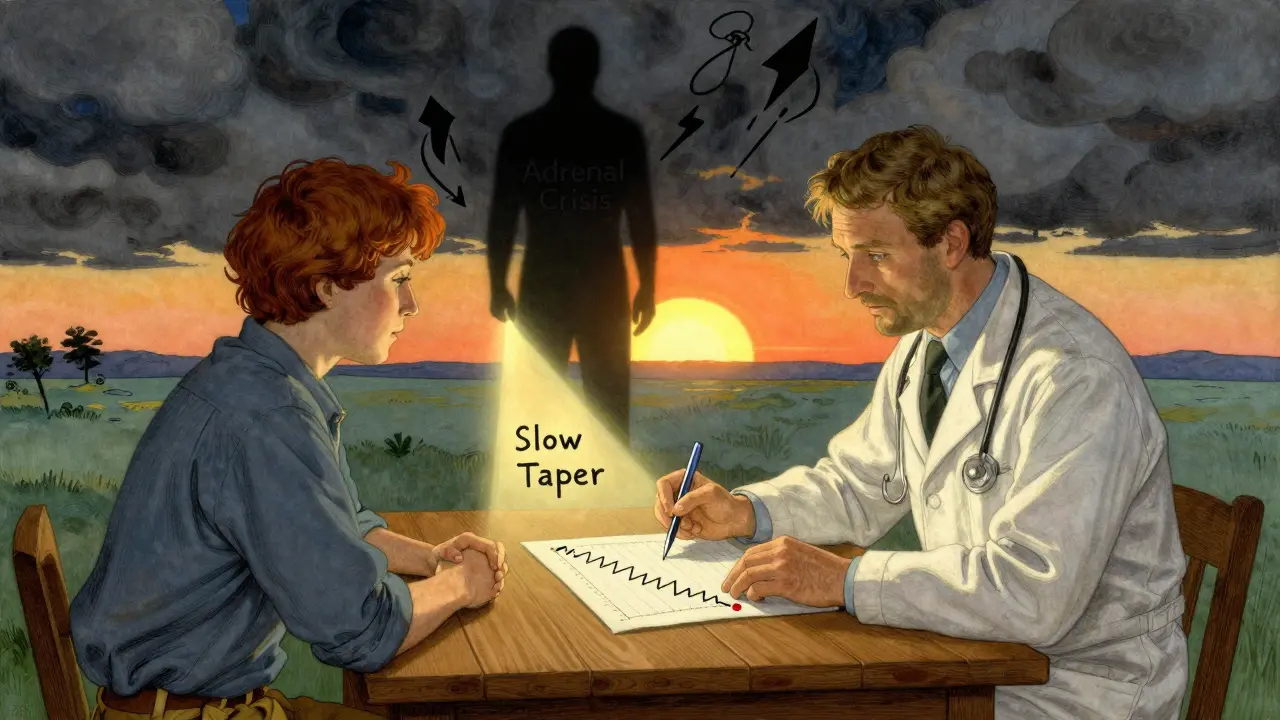
Here’s the rule: if symptoms return or get worse when you lower your dose, you’re going too fast. Don’t push through. Pause. Stay at your current dose for another 7-14 days. Then try dropping again - maybe by half the amount you tried before.
Doctors often use a simple checklist:
- Are you sleeping better than when you started tapering?
- Is your energy level steady, or do you crash every afternoon?
- Are your joints still achy, or are they improving?
- Has your mood stabilized?
If you answer “no” to most of these, slow down. Also, keep a daily log. Write down your dose, how you feel, and any new symptoms. You’ll spot patterns. Maybe you always feel bad on day 3 after a drop. That tells your doctor you need smaller steps.
What to Do When You Get Sick
This is critical. If you’re tapering and you get a cold, flu, infection, or even a bad toothache - your body needs more steroids. Your adrenal glands can’t ramp up production fast enough. This is called “stress dosing.”
Most guidelines say: if you’re on less than 5 mg of prednisone daily and you get sick, temporarily double your dose for the duration of the illness - even if it’s just for a day or two. Then go back to your taper schedule once you’re well.
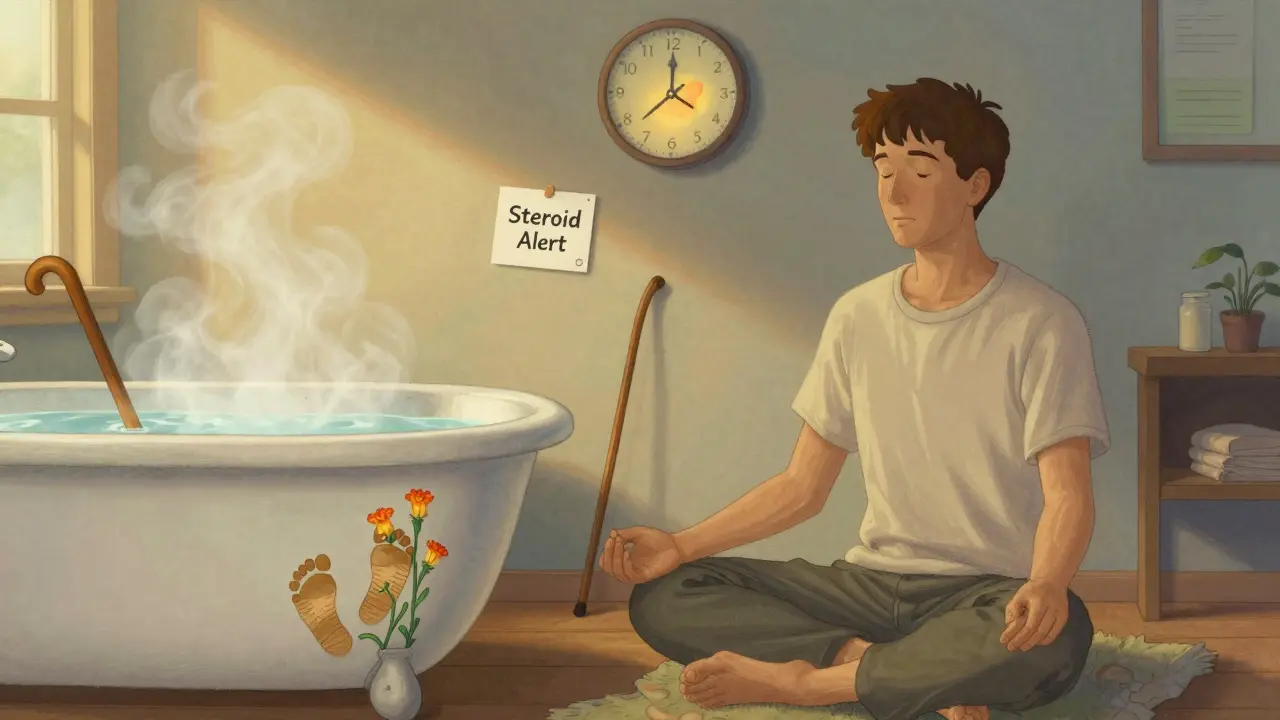
One study found that 18% of emergency visits from recently tapered patients were because they didn’t increase their dose during illness. That’s preventable. Always carry a steroid alert card. It tells paramedics you need steroids in an emergency. Your doctor should give you one before you finish tapering.
Non-Drug Strategies That Actually Help
Medication isn’t the only tool. Lifestyle changes can cut withdrawal symptoms by up to a third.
- Movement: Gentle walking 10-15 minutes twice a day reduces joint stiffness by 57% compared to resting. Don’t push hard - just move.
- Warm water: Swimming or soaking in a warm tub eases muscle pain and improves circulation.
- Meditation: Ten minutes a day of deep breathing or guided meditation lowers anxiety and fatigue scores by 43% in clinical trials.
- Sleep hygiene: Keep a regular bedtime. Avoid screens an hour before sleep. Your body repairs cortisol pathways during deep sleep.
One patient on GoodRx tapered off 40 mg over 14 weeks with zero symptoms. Her secret? Daily walks, warm baths, and a 10-minute meditation app every morning. She didn’t change her meds - she just supported her body.
What Happens After You Stop?
Even after you take your last pill, your body isn’t done adjusting. It can take up to 18 months for your adrenal glands to fully wake up and start making cortisol again. That’s why you need to stay alert for a full year after stopping.
Signs your HPA axis is still recovering:
- Feeling wiped out after a long day
- Needing more sleep than before
- Still feeling achy in cold weather
These aren’t signs you need to go back on steroids. They’re signs your body is still healing. Give it time. Don’t panic if you feel “off” months after stopping. That’s normal.
Some newer tools are emerging. A 2023 study showed that a simple CRH stimulation test can predict whether your adrenal glands are ready to quit steroids - with 89% accuracy. But it’s only available in specialized clinics. For most people, patience and listening to your body are still the best guides.
What’s the Bottom Line?
Steroid tapering isn’t about speed. It’s about safety. Rushing leads to crisis. Moving too slow means unnecessary side effects. The goal is balance: reduce just enough to let your body recover, but not so fast that you trigger withdrawal or disease flare.
Follow your doctor’s plan. Keep a symptom journal. Never skip doses or change your schedule without talking to your provider. And always, always increase your dose when you’re sick. Your body didn’t forget how to make cortisol - it just needs time to remember.
Most people who taper slowly and carefully end up off steroids without complications. It’s not easy. But it’s possible. And it’s worth it.
Can I stop prednisone cold turkey if I’ve only been on it for two weeks?
If you’ve been on prednisone for less than three weeks, you may be able to stop without a taper. But even then, it’s safer to reduce slowly. Your body might still have suppressed cortisol production. Always check with your doctor - never assume it’s safe to stop abruptly.
Why do I feel worse when I lower my steroid dose?
It’s not your disease coming back - it’s your body trying to restart its own cortisol production. Steroids suppress your adrenal glands. When you lower the dose, your body has to wake them up. That process causes fatigue, joint pain, and mood changes. These are withdrawal symptoms, not a flare. Slowing the taper usually helps.
Is hydrocortisone better than prednisone for tapering?
Hydrocortisone is closer to natural cortisol and has a shorter half-life, which some doctors believe helps the adrenal glands recover faster. But studies show no significant difference in success rates compared to slowly tapering prednisone. Unless you’re having trouble with prednisone, switching isn’t necessary.
What should I do if I get sick while tapering?
Increase your steroid dose temporarily - often double your current dose - until you recover. Your body needs extra steroids to handle stress from infection or illness. Not doing this is the most common reason for adrenal crisis after tapering. Always carry a steroid alert card.
How long does it take for my adrenal glands to recover after stopping steroids?
It can take anywhere from a few months to 18 months for your adrenal glands to fully recover and produce cortisol normally again. Most people feel better within 6-12 months, but you should still be cautious about stress, illness, or injury for at least a year after stopping.
What to Do Next
Start by getting your tapering plan in writing. If your doctor hasn’t given you one, ask for it. Make sure it includes exact daily doses, when to pause, and what to do if you get sick. Keep a symptom journal. Use a simple app or notebook to track your dose, mood, energy, and pain levels. Share it with your doctor at every visit.
If you’re struggling - if symptoms are too intense or you’re unsure - don’t push through. Call your doctor. You’re not failing. You’re learning how your body works. Steroid tapering isn’t a race. It’s a slow, careful return to balance. And done right, it’s one of the most powerful things you can do for your long-term health.





Carolyn Whitehead
I tapered off prednisone over 8 months and honestly it felt like climbing a mountain in flip flops
Some days I could barely get out of bed but I kept walking even if it was just to the mailbox
My joints ached like I’d been hit by a truck but I didn’t quit
Turns out my body just needed time to remember how to breathe on its own
Diksha Srivastava
You got this!! I was on 60mg for 10 months and now I’m off with zero flares
Trust the process even when it sucks
Small steps add up
Sarah Blevins
The claim that 60% fewer withdrawal symptoms occur with structured tapering lacks statistical context. The referenced study had a sample size of n=47 and no control for baseline cortisol levels. Methodologically questionable.
Jason Xin
Yeah because nothing says 'medical wisdom' like a Reddit post that cites a study with n=47 and calls it gospel
Meanwhile my rheumatologist said 'if you feel like you're dying, you're probably not dying, just your adrenals being dramatic'
Yanaton Whittaker
AMERICA STILL STRONGEST WHEN IT COMES TO MEDICAL ADVICE 😤🇺🇸
NO OTHER COUNTRY TAKES THIS SERIOUSLY
YOU WANT TO QUIT STEROIDS? DO IT RIGHT OR STAY ON THEM FOREVER
AMERICA NEVER QUITS
Kathleen Riley
The physiological recalibration of the hypothalamic-pituitary-adrenal axis following exogenous glucocorticoid cessation represents a complex neuroendocrine reestablishment event requiring temporal alignment with endogenous circadian rhythms and cortisol pulsatility dynamics.
One cannot merely reduce dosage linearly without accounting for receptor downregulation kinetics.
Donna Fleetwood
I started walking 10 minutes a day during my taper and it changed everything
Not because it 'cured' anything but because it reminded me I still had a body that could move
Some days that was all I needed
Sazzy De
My doc told me to drop 2.5mg every two weeks but I got so wiped out I just stayed at 5mg for six weeks
Didn't feel guilty
Didn't rush
Just listened
Now I'm off and my energy's back
It's not about speed it's about not collapsing
Gaurav Meena
From India here - we don't always have access to specialists but I printed this out and showed my local doctor
He was surprised but said 'you're right, let's slow it down'
Small victories
Thank you for writing this
Jodi Olson
The concept of 'taper tantrums' is anthropomorphizing a neuroendocrine feedback loop
It reduces a biological adaptation to a childish metaphor
Perhaps we should refer to it as 'adrenal recalibration distress syndrome' - more accurate, less dismissive
Amy Insalaco
The entire premise is flawed. The HPA axis doesn't 'forget' how to produce cortisol - it undergoes downregulation of CRH and ACTH receptor sensitivity due to prolonged glucocorticoid receptor occupancy and subsequent negative feedback suppression
Furthermore, the assertion that hydrocortisone offers superior adrenal recovery is empirically unsupported in the literature - the 2021 study you cite explicitly states no significant difference in HPA axis restoration at 12 months post-taper between cohorts
Also, 'taper tantrums'? This is the kind of pop-medical nonsense that erodes clinical credibility
Katie and Nathan Milburn
I appreciate the thoroughness of this post. It aligns with current endocrine guidelines from the Endocrine Society and the American College of Rheumatology regarding glucocorticoid withdrawal.
One minor note: the 18-month recovery window is supported by longitudinal ACTH stimulation testing data from the NIH cohort studies, though individual variability remains significant.
kate jones
Stress dosing is non-negotiable. I had a tooth infection at 2.5mg and didn't increase - ended up in the ER with hypotension and hyponatremia
Now I carry my steroid card everywhere
And I tell every family member what to do if I pass out
This isn't drama - it's survival
Natasha Plebani
There’s a deeper metaphysical layer here - the steroid taper isn’t merely a physiological recalibration, but a ritual of reclamation: the body, having surrendered autonomy to synthetic cortisol, must reassert its sovereignty over endogenous rhythm. In this sense, the fatigue, the achiness, the sleeplessness - these are not symptoms of withdrawal, but the quiet rebellion of the self against chemical domination. The mind forgets how to be unmedicated. The body remembers. And in that remembering lies the slow, sacred return to wholeness.