
When you hear "generic drug," you probably think of a cheaper version of your prescription pill-same active ingredient, same effect, lower price. That’s straightforward. But what about "biosimilar"? It sounds like it should be the same thing. It’s not. And confusing the two can cost you more than just money-it can affect your treatment.
What exactly is a generic drug?
Generic drugs are the chemical twins of brand-name medications. Take ibuprofen, for example. The brand version might be Advil, but the generic is just ibuprofen-same molecule, same dose, same way it works in your body. These are small-molecule drugs, made from simple chemical compounds you can mix in a lab like baking a cake with exact measurements.
Once the patent on a brand-name drug expires, other companies can make the exact same chemical formula. The FDA doesn’t require them to run full clinical trials again. They just need to prove their version gets absorbed into your bloodstream at the same rate and to the same level as the original. That’s called bioequivalence. If it’s within 80-125% of the original, it’s approved.
There are over 10,000 generic drugs approved in the U.S. today. They make up 90% of all prescriptions filled, but only about 20% of total drug spending. Why? Because they’re cheap. On average, generics cost 40-50% less than the brand-name version. For something like metformin or lisinopril, you might pay $4 for a 30-day supply instead of $50.
What makes a biosimilar different?
Biosimilars are not chemical copies. They’re biological copies. That means they come from living cells-usually engineered yeast, bacteria, or mammalian cells grown in labs. These are large, complex proteins, often thousands of times bigger than a small-molecule drug.
Think of insulin, adalimumab (Humira), or trastuzumab (Herceptin). These are biologics. They’re not just molecules; they’re intricate structures with folds, shapes, and even tiny sugar chains attached. Even tiny changes in how they’re made-temperature, pH, cell line, purification method-can change how they behave in your body.
A biosimilar isn’t identical to the original biologic. It’s "highly similar." The FDA requires manufacturers to prove there are no clinically meaningful differences in safety, purity, or potency. That means testing over 200 structural and functional characteristics. Animal studies. Immunogenicity tests. Sometimes small clinical trials. All of this costs $100-200 million per product. That’s 50 times more than making a generic.
As of November 2023, the FDA has approved 42 biosimilars. That sounds like a lot, but it’s a drop in the bucket compared to 10,000+ generics. And they’re not cheap-just cheaper. Biosimilars typically save 15-33% off the brand-name price. That’s less than generics, but still meaningful for drugs that cost $20,000-$100,000 a year.
Why can’t biosimilars be called "generic biologics"?
That’s a common mistake. You can’t call a biosimilar a "generic" because they’re not the same thing. Generics are exact copies. Biosimilars are very close copies-like a high-resolution photo of a painting versus the original. You can’t see the difference with the naked eye, but under a microscope, the brushstrokes vary.
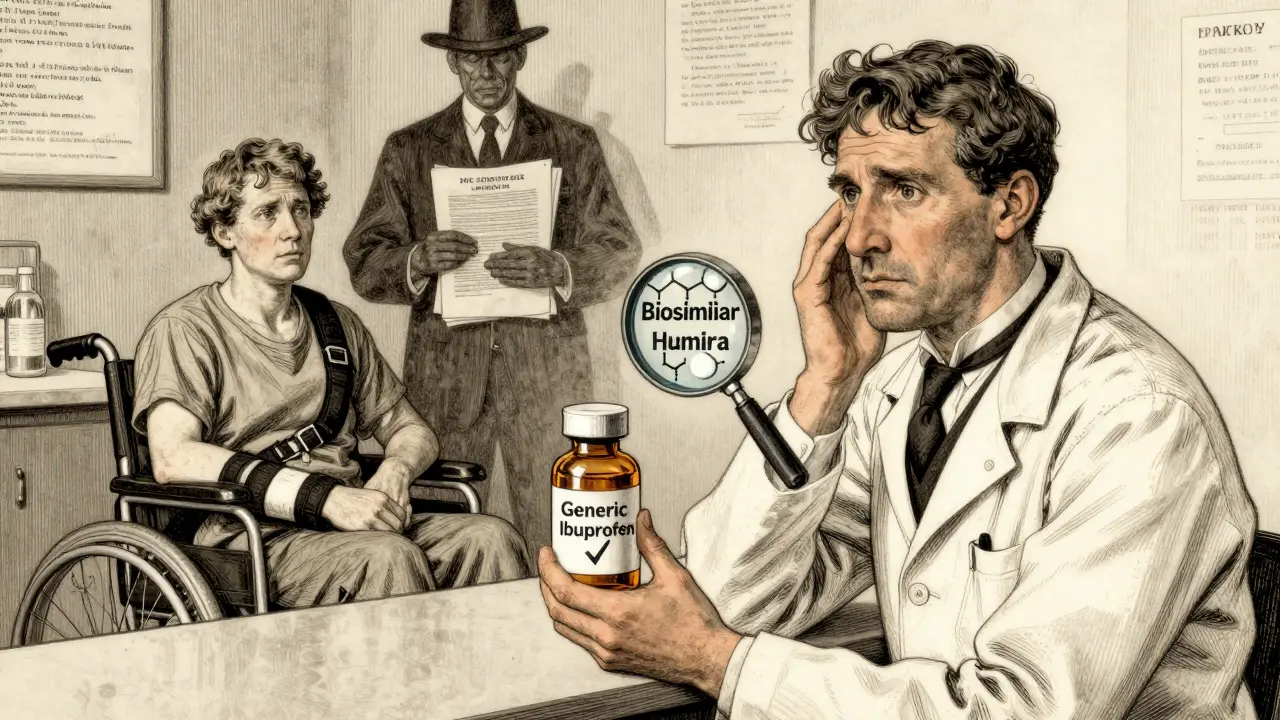
Here’s why it matters: because biosimilars are made from living cells, each batch has tiny natural variations. That’s normal. But those variations can, in rare cases, trigger immune reactions. That’s why switching from a brand-name biologic to a biosimilar isn’t always automatic.
Doctors and patients need to be cautious. If you’ve been stable on Humira for years, switching to a biosimilar might be fine. But if you’re on a complex therapy like an antibody-drug conjugate for cancer, switching without monitoring could carry risk. The American Society of Health-System Pharmacists says biosimilars aren’t automatically substitutable-unlike generics.
Can pharmacists swap them like generics?
With generics? Yes. In every state, pharmacists can swap a brand-name drug for its generic without asking your doctor. That’s called automatic substitution.
With biosimilars? Not so fast. Only those labeled "interchangeable" by the FDA can be swapped without the prescriber’s permission. As of 2023, only 7 out of the 42 approved biosimilars have that status. The rest require a new prescription if you want to switch.
The first interchangeable biosimilar for Humira, Amjevita, got approved in March 2023 and hit the market in January 2024 with a 35% price cut. That was a big deal. But it’s still the exception, not the rule.
How do approval processes compare?
Generics follow the Hatch-Waxman Act of 1984. The path is clear: prove bioequivalence. No need for new clinical trials on safety or effectiveness. Just show your pill dissolves the same way and your blood levels match.
Biosimilars follow the Biologics Price Competition and Innovation Act (BPCIA) of 2009. The process is step-by-step:
- Compare structure and function using advanced lab tests
- Run animal studies
- Test immunogenicity (how likely it is to trigger an immune response)
- Perform pharmacokinetic and pharmacodynamic studies
- Maybe run a small clinical trial
The FDA doesn’t require full-scale trials like the original biologic had, but it’s still a much longer, more expensive road.
Where are biosimilars used-and where are generics?
Generics are everywhere: blood pressure pills, antidepressants, antibiotics, cholesterol meds. If it’s a small molecule, there’s probably a generic version.
Biosimilars are mostly in high-cost, specialty areas:
- Oncology: Trastuzumab (for breast cancer), bevacizumab (for colon cancer)
- Immunology: Adalimumab (Humira), etanercept (Enbrel) for rheumatoid arthritis
- Endocrinology: Insulin glargine for diabetes
These are drugs that used to cost $50,000-$100,000 a year. Even a 20% discount saves patients and insurers tens of thousands. That’s why hospitals and specialty pharmacies have been early adopters-45% of U.S. hospitals now use at least one biosimilar.

Why aren’t biosimilars more popular?
Cost isn’t the only barrier. There’s also:
- Provider hesitation: A 2022 survey found 68% of rheumatologists needed more education before prescribing biosimilars. Many worry about switching patients who are stable.
- Reimbursement issues: In the U.S., many biologics are "buy-and-bill"-hospitals buy them, then bill insurance. If a biosimilar is cheaper, the hospital makes less profit. That creates a financial disincentive to switch.
- Patent thickets: Companies like AbbVie have filed over 240 patents on Humira to delay competition. It took until 2023 for biosimilars to really enter the market, even though the first was approved in 2016.
- Limited education: Patients don’t know what biosimilars are. Pharmacists aren’t always trained to explain them. Resources like the FDA’s "Purple Book" (which lists biosimilars) are harder to navigate than the "Orange Book" (for generics).
In Europe, biosimilars make up 35% of the biologics market. In the U.S.? Less than 3%. That gap is starting to close, thanks to the Inflation Reduction Act, which cuts out-of-pocket costs for Medicare Part D users.
What’s next for biosimilars?
The future looks promising. Major biologics like Stelara (ustekinumab) and Eylea (aflibercept) are losing patent protection in the next few years. Analysts predict biosimilars could capture 25-30% of the U.S. biologics market by 2028.
New types are coming too-"bio-super-similars" with improved properties, like longer-lasting effects or fewer side effects. The FDA is also working on clearer guidance for interchangeability, especially for complex drugs like antibody-drug conjugates.
But the big question remains: will the savings reach patients? Or will insurers and pharmacies keep the bulk of the discount?
Bottom line: Choose wisely
Generics are safe, proven, and affordable. If your doctor prescribes a generic, you can trust it. No guesswork.
Biosimilars are a breakthrough for expensive biologics. They’re not perfect copies, but they’re close enough to be safe for most people-when used correctly. Always ask: Is this biosimilar interchangeable? Have you used it before? Are you being monitored?
Don’t assume "similar" means "the same." In medicine, those tiny differences matter.
Are biosimilars as safe as brand-name biologics?
Yes. The FDA requires biosimilars to show no clinically meaningful differences in safety, purity, or potency compared to the original biologic. Thousands of patients have used them without increased risk. But because they’re made from living cells, there’s a small chance of immune reactions, especially if switching from one product to another. Monitoring is recommended during the first few doses.
Can I switch from a brand-name biologic to a biosimilar on my own?
No. Only biosimilars labeled "interchangeable" by the FDA can be substituted by a pharmacist without a new prescription. Even then, your doctor should be informed. For non-interchangeable biosimilars, you need a new prescription. Never switch on your own-especially for chronic conditions like rheumatoid arthritis or cancer.
Why are biosimilars more expensive than generics?
Because they’re far more complex to make. Generics are simple chemical compounds you can replicate exactly. Biosimilars are large proteins grown in living cells-each batch varies slightly. Developing one requires hundreds of lab tests, animal studies, and clinical trials. The cost to bring one to market is $100-200 million, compared to $2-5 million for a generic.
Do biosimilars work as well as the original biologic?
Yes, for approved indications. The FDA requires biosimilars to perform the same way as the reference product in clinical trials. For example, biosimilars for Humira work just as well for rheumatoid arthritis. But they’re only approved for the same uses as the original. If the original is used for five conditions, the biosimilar may only be approved for three-unless the FDA allows "extrapolation," which requires strong scientific justification.
Are biosimilars covered by insurance?
Most are, but coverage varies. Many insurers prefer biosimilars because they’re cheaper than the brand-name biologic. However, some plans still require prior authorization or step therapy-meaning you must try the brand-name first. The Inflation Reduction Act is helping by lowering out-of-pocket costs for Medicare Part D beneficiaries, which should increase access.
If you’re prescribed a biosimilar, ask your doctor or pharmacist: Is it interchangeable? Has it been used successfully in patients like me? What should I watch for? Being informed gives you control-and better outcomes.




Jan Hess
Man I wish more people knew this difference. I was on Humira for years and my doc switched me to a biosimilar last year. Saved me like $800 a month. No issues. My body didn’t even notice. Just cheaper magic.
Stop treating biosimilars like they’re sketchy. They’re not.
Also why is the FDA so slow on interchangeables? We need more of those.
Iona Jane
They’re lying to you. Biosimilars are a Big Pharma trap. The same companies that made Humira own the biosimilars now. They just repackaged the same drug with a new label. You think they’d let you save money? No. They’re just moving the goalposts so you keep paying. Watch your bloodwork. Something’s off. I know it.
Jaspreet Kaur Chana
In India we’ve been using biosimilars for over a decade now and they’re a game-changer. My cousin with rheumatoid arthritis was paying $15,000 a year for Enbrel before. Now she takes a biosimilar for $1,500. Same results. Same doctor. Same life.
People in the US act like this is some new sci-fi thing. No. We’ve been doing this since 2012. The science is solid. The problem isn’t the drug - it’s the system. Insurance companies, patent lawyers, and hospital profit margins are the real villains here. Not the science.
Also, the term ‘biosimilar’ sounds scary because it’s not ‘generic.’ But we call them ‘bio-generics’ in Mumbai. Simple. Clear. No confusion. Why can’t we do that here?
Haley Graves
Stop confusing people with semantics. If it works the same, saves money, and is FDA-approved, use it. Your insurance will thank you. Your wallet will thank you. Your body won’t care if it’s called ‘biosimilar’ or ‘generic biologic.’ What matters is whether you get treated.
Don’t let fear of jargon keep you from affordable care. Ask your doctor. Get the data. Then decide. But don’t let a label scare you out of a better option.
Diane Hendriks
The entire U.S. healthcare system is built on linguistic obfuscation. You call a biosimilar a ‘biosimilar’ to make it sound exotic, complex, and therefore more dangerous - when in fact it’s just a cheaper version of a drug that was overpriced to begin with. The word ‘generic’ is clean. Honest. Transparent. But ‘biosimilar’? That’s marketing. That’s fearmongering. That’s the pharmaceutical industry’s attempt to maintain control over language to preserve pricing power.
And let’s not forget: the FDA approved 42 biosimilars, yet only 7 are interchangeable? That’s not science. That’s politics. That’s lobbying. That’s corruption dressed up as regulation.
ellen adamina
I’ve been on a biosimilar for my psoriasis for 18 months now. No flare-ups. No weird reactions. My skin is better than it’s been in years.
But I still don’t know if it’s interchangeable. I never asked. I just took what the pharmacy gave me.
Should I have? Is that dangerous? I just want to know if I’m safe.
Also - how do I even find out if my drug is interchangeable? Is there a list somewhere? The pharmacist didn’t say anything.
Gloria Montero Puertas
Oh, so now we’re just supposed to trust these… ‘biosimilars’? Because the FDA says so? Please. You think the FDA doesn’t have industry ties? You think the $100 million spent on approval didn’t come from the same companies that made the original? And you call that ‘science’? It’s a corporate handshake wrapped in a white coat.
And don’t even get me started on the ‘interchangeable’ label - that’s not a medical term, that’s a legal loophole. They’re playing chess with your health while you think you’re just buying pills.
And you wonder why people are sick? It’s because the system is rigged. Always has been.
Tom Doan
So let me get this straight. A generic drug costs $2 million to develop. A biosimilar costs $150 million. And yet, the biosimilar only saves you 20-30%? That’s not a market inefficiency - that’s a cartel. The entire system is designed to make you pay more for something that’s technically ‘similar’ but legally distinct. The FDA’s process is so convoluted it might as well be written in Latin.
And we’re supposed to be impressed by the ‘complexity’? No. We’re supposed to be furious. This isn’t innovation. It’s extortion with a lab coat.
Sohan Jindal
Generics are American. Biosimilars are foreign junk. They let China and India make these things and then say it’s safe. Bullshit. Our doctors used to prescribe real medicine. Now we’re guinea pigs for foreign labs. And the government lets it happen. Why? Because they don’t care about us. They care about profits. And now they want you to trade your life for a discount. I won’t take it.