
Adolescent Medication Monitoring Timeline Calculator
Start Date & Risk Factors
Risk Factors
Recommended Monitoring Schedule
Key Questions to Ask
- "Have you had any thoughts about not wanting to be here anymore?"
- "Do you ever feel like things will never get better?"
- "What's the hardest part about taking this medicine right now?"
- "Do you feel like this medicine is helping, or is it making things harder?"
Critical Monitoring Period
When an adolescent starts psychiatric medication, the goal is relief-not risk. But for some, especially in the first few weeks, these medications can unintentionally increase thoughts of self-harm or suicide. This isn’t common, but it’s real enough that every clinician, parent, and caregiver must know how to watch for it-and what to do when it shows up.
Why This Happens
Antidepressants and other psychiatric drugs don’t work like painkillers. You don’t feel better right away. In fact, many teens report feeling more anxious, restless, or emotionally raw before they start to improve. This isn’t a sign the medication isn’t working-it’s often part of how it works. But in a vulnerable brain, that temporary surge in energy and emotional awareness can make suicidal thoughts feel more urgent, more real. The U.S. Food and Drug Administration (FDA) put a black box warning on all antidepressants in 2004 after studies showed a small but measurable increase in suicidal thinking among kids and teens under 25 during the first 1-2 months of treatment. It wasn’t that the drugs caused suicide. It was that they sometimes gave enough energy to act on thoughts that were already there. That’s why monitoring isn’t optional. It’s the difference between safety and crisis.Who’s at Highest Risk?
Not every teen on medication needs the same level of attention. But some are more vulnerable:- Teens with a history of suicide attempts-even if it was years ago.
- Those with severe depression or mixed anxiety-depression-especially if they’ve been untreated for a long time.
- Teens starting multiple medications at once-combining antidepressants with stimulants or antipsychotics increases complexity.
- Those with substance use-alcohol, marijuana, or other drugs can worsen mood instability.
- Teens in unstable home environments-lack of consistent adult supervision makes early warning signs harder to catch.
One study found that 68% of suicide-related incidents in teens on medication occurred within the first 30 days. That’s why the first month is the most critical.
What Monitoring Actually Looks Like
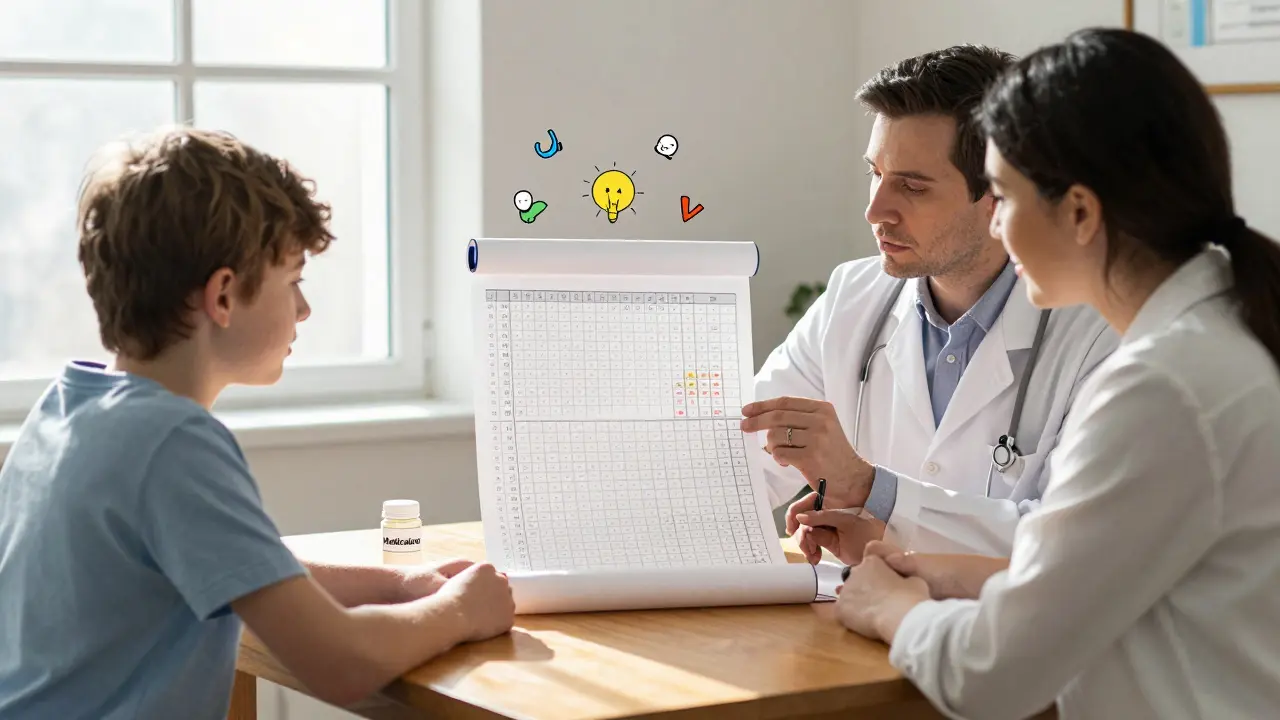
Monitoring isn’t just asking, “Are you having thoughts of hurting yourself?” That’s too vague, and teens often say “no” because they don’t want to worry their parents or get in trouble. Effective monitoring is structured, consistent, and specific.Here’s what top guidelines from California, New York, and the American Academy of Child and Adolescent Psychiatry (AACAP) agree on:
- First visit after starting medication: Within 1 week. Don’t wait for the 2-week follow-up. This is when side effects peak.
- Second visit: At 2 weeks. Check for changes in sleep, energy, irritability, or withdrawal.
- Third visit: At 4 weeks. Evaluate whether mood has improved-or worsened. Ask: “Do you feel like things are getting better, or are you still stuck?”
- After that: Every 2-4 weeks for the first 3 months. Then monthly if stable.
But frequency isn’t everything. What you ask matters more.
Ask the Right Questions
Instead of: “Are you suicidal?” Try these instead:- “Have you had any thoughts about not wanting to be here anymore?”
- “Do you ever feel like things will never get better?”
- “Have you thought about how you’d feel if you weren’t around?”
- “What’s the hardest part about taking this medicine right now?”
- “Do you feel like this medicine is helping, or is it making things harder?”
Use open-ended questions. Let silence sit. Don’t rush to fix it. Many teens will open up if they feel heard, not judged.
What to Do If Suicidal Thoughts Show Up
If a teen says they’re having suicidal thoughts, don’t panic-but don’t downplay it either.- Don’t stop the medication immediately. Abruptly stopping can cause withdrawal symptoms that worsen mood swings.
- Do increase monitoring. Go from monthly to weekly visits. Call the family between visits if needed.
- Do involve the family. Parents need to know how to check in daily-not just ask, “How are you?” but notice changes: “You haven’t touched your phone all day. Is something going on?”
- Do consider dose adjustments. Sometimes lowering the dose reduces side effects without losing benefit. California guidelines say clinicians must document whether the dose is at the “minimum effective level.”
- Do explore alternatives. Therapy, school support, or switching to a different medication class may be needed.
One teen told her psychiatrist: “I didn’t want to die-I just wanted the pain to stop.” That’s the difference between suicidal ideation and intent. Recognizing that helps guide the response.
Monitoring Doesn’t Stop When the Medication Does
Many clinicians forget this: the risk doesn’t vanish when the medication is stopped. In fact, tapering off can trigger a rebound in depressive symptoms or withdrawal-related anxiety.Guidelines from Oklahoma and New York say: “Patients may need to be seen more frequently during discontinuation.” That means:
- Slow tapering-no faster than 10% per week.
- Weekly check-ins for at least 2-4 weeks after the last dose.
- Watch for: insomnia, irritability, crying spells, isolation.
One study found that 31% of teens who stopped antidepressants without proper tapering had a return of suicidal thoughts within 3 weeks. That’s why discontinuation isn’t the end of monitoring-it’s a new phase.
The Hidden Gaps in Care
Even with clear guidelines, real-world care is messy.- Only 57% of outpatient clinics have standardized suicide monitoring protocols. Many rely on memory or outdated forms.
- Only 34% of child psychiatry residents get 8+ hours of training in how to monitor for medication-induced suicidal ideation.
- 42% of psychiatry fellows report inadequate training in getting truly informed consent about suicide risk.
- Schools and outpatient providers rarely talk. A teen might be suicidal during school hours, but the psychiatrist doesn’t know unless someone calls.
These gaps aren’t excuses-they’re red flags. If you’re a parent, don’t assume the doctor is watching. Ask: “What’s the plan to check for suicidal thoughts? How often? Who calls if something changes?”
What Parents Can Do
You’re not a clinician-but you’re the most important monitor.- Keep a mood journal. Note sleep, appetite, energy, school attendance, and any mention of hopelessness.
- Lock up medications. Especially if there’s any history of self-harm. A single extra pill can be dangerous.
- Know the warning signs. Giving away belongings, sudden calm after deep depression, writing about death, withdrawing from friends.
- Call the provider immediately if you notice a sudden change-don’t wait for the next appointment.
- Use the same language as the clinician. If they ask, “Do you feel like things will never get better?”-ask the same question.
One mother noticed her son stopped talking about his favorite video game. He’d been obsessed for years. When she asked why, he said, “It doesn’t matter anymore.” That was her signal. She called the psychiatrist the next day. He was reassessed, the dose was lowered, and within two weeks, he started talking again.
The Future of Monitoring
Technology is starting to help. Some clinics now use digital tools that ask teens daily questions about mood, sleep, and thoughts. These tools can flag rising risk before a crisis hits. But they’re not perfect-only 19% of digital tools are designed specifically for medication-related suicidal ideation.Research is also looking at biological markers-brain activity patterns, stress hormones, gene expression-that might predict who’s at risk. The National Institute of Mental Health is funding $28.7 million in research on this right now.
But for now, the best tool is still a person who shows up-consistently, carefully, and without judgment.
Do all psychiatric medications carry a suicide risk for teens?
No, not all. The FDA black box warning only applies to antidepressants and some mood stabilizers. But experts now agree that any psychiatric medication-whether it’s for ADHD, anxiety, psychosis, or depression-can potentially trigger emotional instability in vulnerable teens. That’s why monitoring for suicidal ideation should be part of every medication plan, not just for antidepressants. A 2023 guide from MedPsych Health states this clearly: monitoring must be universal across all medication classes.
How long does the suicide risk last after starting medication?
The highest risk is in the first 1-2 months, especially the first 10-14 days. After that, risk drops significantly if the teen is responding well. But if symptoms worsen after 4-6 weeks, that’s a red flag. Some teens experience delayed reactions. That’s why monitoring continues for at least 3 months, even if things seem fine.
Can therapy replace medication for suicidal teens?
Therapy alone can help many teens, especially with mild to moderate depression. But for those with severe symptoms, poor sleep, or inability to function at school, medication may be necessary to create a window for therapy to work. The goal isn’t to choose one or the other-it’s to use both together. A 2022 study showed that teens who got both CBT and medication had a 60% lower rate of suicidal ideation than those who got therapy alone.
What if my teen refuses to talk about suicidal thoughts?
Don’t force it. Instead, change the setting. Go for a drive. Sit side-by-side instead of facing each other. Use a journal or app to let them write instead of speak. Many teens open up when they feel less pressure. Also, ask the provider to use a validated screening tool like the Columbia-Suicide Severity Rating Scale (C-SSRS)-it’s designed to ask sensitive questions in a non-threatening way.
Is it safe to stop the medication if I’m worried?
Never stop abruptly. Stopping suddenly can cause withdrawal symptoms like nausea, dizziness, insomnia, or worsening mood-and those can increase suicide risk. Always work with the prescribing clinician to taper slowly. Most guidelines recommend reducing the dose by no more than 10% per week. If you’re worried, call the provider immediately-they can adjust the plan.



phyllis bourassa
I've seen this so many times. Parents think meds are magic bullets. Nope. They're like giving a toddler a chainsaw and saying 'be careful.' The first week? Total emotional dumpster fire. I had a client who went from crying in sessions to texting her ex at 3 a.m. within days. You think you're helping, but you're just handing them a loaded gun and saying 'tell me if you feel like pulling it.' And yeah, I know it's not the drug's fault-but someone's gotta hold the safety on.
Susan Purney Mark
This is so important 💔 I wish every parent got this info before signing the consent form. My sister started sertraline and within 10 days she was deleting all her photos and saying 'it doesn't matter anymore.' We called the doc same day-they lowered the dose, added weekly therapy, and boom-within 3 weeks she was drawing again. Not perfect, but alive. Please, if you're reading this: don't wait for the 2-week mark. Call at day 5 if something feels off. You know your kid better than any algorithm.
Ian Kiplagat
In the UK, we’ve got the same black box warning. But the real issue? Access. My niece’s GP waited 17 days for the first follow-up. By then, she’d stopped eating, sleeping, and speaking. We had to escalate to A&E. Monitoring isn’t just protocol-it’s survival. And no, you can’t rely on schools. They’re understaffed. Parents need to be trained, not just informed.
Adebayo Muhammad
Let’s be real: this isn’t about medication. It’s about societal collapse. We’ve turned children into chemical experiments. We’ve removed meaning from life-replaced it with pills, screens, and performance metrics. A 14-year-old doesn’t need an SSRI; they need a mentor, a purpose, a reason to wake up. The system doesn’t want to fix that. It wants to pharmacologize the symptoms. So yes, monitor. But ask: why are we medicating despair instead of rebuilding community?
Pranay Roy
You think this is about medication? Nah. Big Pharma’s been pushing this since the 90s. They know teens are vulnerable. They know parents are scared. So they pump out drugs with black box warnings and call it 'care.' Meanwhile, the real solution-structured youth programs, paid parental leave, mental health days in schools-is ignored. And now we’re blaming the medicine. Classic distraction. The system is rigged. The drugs are just the symptom.
Joe Prism
I’ve been there. My son started on fluoxetine. Week 1: quieter. Week 2: restless. Week 3: 'I just want the noise to stop.' We didn’t stop the med. We didn’t panic. We just showed up. Sat with him. Didn’t fix. Didn’t preach. Just listened. He said: 'It’s like my brain’s screaming but my mouth won’t work.' That’s when I knew: this isn’t about suicide. It’s about being trapped inside yourself. The medicine didn’t cause it. It just made the walls thinner.
Bridget Verwey
Oh honey, you’re telling me to 'ask the right questions' like it’s a TED Talk? 😏 Let’s be real: teens don’t answer questions. They answer vibes. If you’re stressed, they’ll say 'fine.' If you’re calm, they might whisper something real. My daughter didn’t say 'I’m suicidal'-she said 'I’m tired of pretending.' I didn’t ask. I just hugged her. Then I called the doc. No drama. No interrogation. Just: 'Something’s off. Can we tweak the plan?' And guess what? It worked.
Andrew Poulin
Stop overcomplicating this. If a teen says they’re not okay, you act. No waiting. No forms. No 'let’s wait for the 2-week visit.' You call the provider. You lock up meds. You sleep in the same room. You don’t negotiate with depression. You shut it down. This isn’t a policy memo. It’s a life. And if you’re still reading this instead of checking on your kid right now-you’ve already lost.
Weston Potgieter
I’ve been in this game 20 years. Let me tell you what no one says: 80% of the 'suicidal ideation' we see? It’s not real. It’s performative. Teens say it because it gets attention. They’ve seen it on TikTok. They’ve heard it in therapy. It’s the new 'I’m sad.' And now we’re treating every 'I don’t wanna be here' like a code blue. Meanwhile, the ones who actually mean it? They’re silent. They don’t say anything. They just disappear. We’re creating a culture of crisis theater. And it’s making real risk invisible.