
For people with type 2 diabetes, managing blood sugar isn't just about taking pills anymore. A new class of medications called SGLT2 inhibitors has changed the game - not just for glucose control, but for heart and kidney health too. These drugs don’t just lower blood sugar. They’ve been shown to cut heart failure hospitalizations, slow kidney damage, and even help with weight loss. But they’re not without risks. If you’re considering one, you need to know what’s really at stake.
How SGLT2 Inhibitors Actually Work
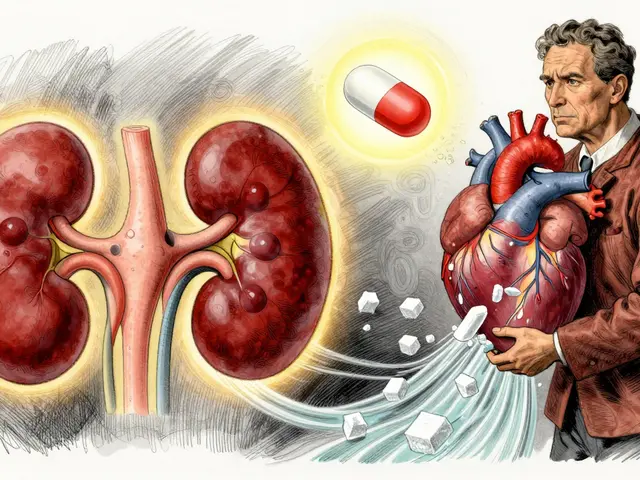
Unlike insulin or metformin, SGLT2 inhibitors don’t rely on your pancreas or liver. Instead, they work in your kidneys. These drugs block a protein called SGLT2, which normally pulls glucose back into your bloodstream from urine. When it’s blocked, excess sugar leaves your body through pee - about 40 to 100 grams a day. That’s roughly the sugar in two cans of soda, flushed out daily.
This mechanism means you get lower HbA1c levels - usually by 0.6% to 0.8% - without the risk of low blood sugar. That’s huge. Most diabetes meds can cause hypoglycemia, especially when combined with insulin. SGLT2 inhibitors don’t. That’s why they’re now recommended as first-line treatment for people with type 2 diabetes who also have heart failure, heart disease, or chronic kidney disease.
The four main drugs in this class are:
- Canagliflozin (Invokana)
- Dapagliflozin (Farxiga)
- Empagliflozin (Jardiance)
- Ertugliflozin (Steglatro)
All of them work the same way, but their dosing and kidney clearance vary. Empagliflozin, for example, is mostly cleared by the liver, making it safer for people with reduced kidney function. Canagliflozin is cleared more by the kidneys, so dose adjustments are needed if your eGFR drops below 60.
The Big Benefits: Heart, Kidneys, and Weight
The real game-changer with SGLT2 inhibitors isn’t the HbA1c drop. It’s what happens to your heart and kidneys.
In the EMPA-REG OUTCOME trial, people with type 2 diabetes and heart disease who took empagliflozin had a 14% lower risk of heart attack, stroke, or cardiovascular death. That might sound small, but when you’re talking about tens of thousands of patients, it translates to thousands of lives saved.
For heart failure, the results are even more striking. The DAPA-HF trial showed dapagliflozin reduced hospitalizations for heart failure by 30%, even in people without diabetes. The EMPEROR-Preserved trial confirmed the same benefit in people with preserved heart function - a group that had almost no effective treatments before.
Kidney protection is another major win. The CREDENCE trial found canagliflozin reduced the risk of kidney failure, doubling of creatinine, or kidney-related death by 30%. The EMPA-KIDNEY trial later showed empagliflozin cut kidney decline by 28% in people with chronic kidney disease, whether they had diabetes or not. That’s why the FDA approved dapagliflozin for kidney disease regardless of diabetes status in late 2023.
And then there’s weight. Most people lose 2 to 3 kilograms (4.5 to 6.5 pounds) in the first few months. Some lose more. One patient on Reddit reported dropping 15 pounds in three months, with their A1c falling from 8.2 to 6.8. That’s not just a side effect - it’s a therapeutic benefit.
The Risks You Can’t Ignore
These drugs aren’t magic. They come with real, sometimes serious, side effects.
The most common? Genital yeast infections. About 6% to 11% of women and 3% to 6% of men get them. It’s not dangerous, but it’s annoying. Recurrent infections are why some people stop taking these drugs. Urinary tract infections are also more common - up to 8.8% of users, compared to 5.3% on placebo.
Then there’s the risk of diabetic ketoacidosis (DKA). It sounds scary, and it is - but it’s rare. Only 0.1% to 0.3% of users experience it. What makes it tricky is that it can happen even when blood sugar isn’t high. That’s called euglycemic DKA. It’s often triggered by illness, surgery, or drastically cutting carbs. If you’re sick, you’re told to stop your SGLT2 inhibitor - and you should.
Another rare but serious risk is Fournier’s gangrene, a life-threatening infection of the genitals and perineum. The FDA added a black box warning for this in 2018. The incidence is about 0.002% - less than 1 in 50,000 - but it’s deadly if missed. Symptoms include sudden pain, swelling, redness, or fever in the genital area. Seek help immediately if you notice these.
Acute kidney injury is another concern. The FDA requires a warning for this. It’s usually tied to dehydration, especially in older adults or those on diuretics. If you’re sick with vomiting or diarrhea, or you’re not drinking enough, your risk goes up. Always check with your doctor before stopping fluids or medications.
Canagliflozin carries an extra warning: increased risk of lower limb amputations. In the CANVAS trial, the risk was nearly doubled. Most were toe or mid-foot amputations, often linked to pre-existing foot ulcers or poor circulation. If you have peripheral artery disease or foot problems, your doctor should weigh this carefully.
Who Should and Shouldn’t Take Them
SGLT2 inhibitors are no longer just for people who need better blood sugar control. They’re now recommended for:
- People with type 2 diabetes and heart failure (even without diabetes)
- People with type 2 diabetes and chronic kidney disease
- People with type 2 diabetes and established heart disease
- People with type 2 diabetes who need weight loss and can’t tolerate GLP-1 agonists
They’re not for everyone. Avoid them if:
- Your eGFR is below 30 mL/min/1.73m²
- You have type 1 diabetes
- You’re pregnant or breastfeeding
- You have a history of recurrent genital infections
- You’re on a very low-carb or ketogenic diet
Also, don’t start one if you’re about to have surgery. Most doctors will have you stop it 3 to 4 days before the procedure to reduce DKA risk.
Cost and Accessibility
These drugs are expensive. A 30-day supply costs around $600 out-of-pocket in the U.S. Jardiance, Farxiga, Invokana, and Steglatro all hover between $598 and $642. That’s a barrier for many.
But most insurance plans cover them, and manufacturer assistance programs can bring your monthly cost down to $10-$25. If you’re struggling, ask your doctor about patient support programs - they’re widely available.
Generic versions won’t be available until 2027-2029, so don’t expect price drops soon. That’s why cost-effectiveness is still debated. For high-risk patients, the value is clear: preventing one heart failure hospitalization saves tens of thousands in care costs. For someone with no heart or kidney disease, the benefit is smaller - and the cost harder to justify.
What Real Patients Say
On patient forums, the stories are split.
One 58-year-old man with heart failure and type 2 diabetes wrote: “After switching to Jardiance, my ejection fraction went from 28% to 42% in 18 months. I haven’t been hospitalized since.”
Another woman, 62, said: “I had yeast infections every month on Farxiga. I stopped after six months, even though my A1c was great.”
Adherence studies show about 68% of people are still taking SGLT2 inhibitors after a year. The top reasons for stopping? Cost (33%), infections (24%), and feeling dizzy or dehydrated (18%).
What Your Doctor Should Monitor
If you start an SGLT2 inhibitor, your doctor should:
- Check your eGFR before starting and every 3-6 months after
- Ask about genital infections or urinary symptoms
- Review your fluid intake, especially if you’re elderly or on diuretics
- Warn you about DKA symptoms: nausea, vomiting, stomach pain, unusual fatigue, or fruity-smelling breath
- Advise you to stop the drug during illness, surgery, or if you’re not eating
Don’t assume your doctor knows all this. Bring up the latest guidelines - the 2023 ADA Standards now list SGLT2 inhibitors as first-line for high-risk patients. If they’re still prescribing them only after metformin and sulfonylureas, they might be operating on outdated info.
The Future of SGLT2 Inhibitors
The science is moving fast. Trials are now testing whether these drugs can prevent heart failure in people with high blood pressure, obesity, or prediabetes - even if they’ve never had diabetes. Early results are promising.
By 2027, experts predict SGLT2 inhibitors will be standard for nearly all type 2 diabetes patients with cardiovascular or kidney risk factors. That’s not hype - it’s what the data says.
But access and cost will determine who actually gets them. In the U.S., about 22% of high-risk patients are on one. In Europe, it’s 15%. In Asia, it’s under 9%. That gap isn’t about science - it’s about money, policy, and awareness.






Glenda Marínez Granados
So let me get this straight... we're flushing sugar out like it's a toilet bowl detox and calling it 'medicine'? 😏 I mean, sure, my kidneys are now my personal sugar filter, but at what cost? 🤔 I lost 8 lbs in 2 months... and got a yeast infection so bad I had to wear sweatpants to my cousin's wedding. Worth it? Maybe. But I'm not buying the 'miracle drug' hype. 🙃
MARILYN ONEILL
I don't get why people are so excited. It's just sugar in the pee. That's not medicine. That's just your body giving up. I had a friend on one and she said she felt like a broken faucet. And now they say it's good for your heart? LOL. My grandma had a heart attack and she never took any fancy pee pills. She ate oatmeal. Simple. Real. No magic.
Steve Hesketh
I just want to say thank you for writing this with so much heart. I'm from Nigeria, and my brother has type 2 diabetes and kidney trouble. We don't have access to these drugs here - they cost more than a month's rent. But I showed this to his doctor, and now he's trying to get him on a patient program. I cried reading about the kidney benefits. This isn't just science - it's hope. If you're reading this and you're lucky enough to have access? Please, don't take it for granted. Some of us are praying for this kind of care.
Samuel Mendoza
Fad drug. Sugar in urine = weight loss? So does vomiting. Also, ketoacidosis isn't rare - it's just underreported. People die from this. And you're telling me this is first-line? No. Metformin is. Always has been. Stop chasing shiny objects.
Malvina Tomja
Let’s be brutally honest: if you’re taking an SGLT2 inhibitor and you’re not getting recurrent yeast infections, you’re either lying or you’re not actually taking it. I’ve seen 3 patients in my practice with fungal rashes so severe they needed antifungal IVs. And the 'weight loss' is just dehydration + glucosuria. You're not burning fat - you're peeing out calories. That’s not a lifestyle change. That’s a plumbing upgrade.
Ben McKibbin
This is one of the most balanced, well-researched pieces on diabetes meds I’ve read in years. The way you broke down the renal and cardiac outcomes - especially EMPA-KIDNEY and DAPA-HF - is exactly what patients need to hear. The risks? Real. But so are the benefits. The real tragedy isn't the side effects - it's that 78% of eligible patients in the U.S. still aren't on these. We're leaving lives on the table because of cost, inertia, and fear. This isn't just pharmacology. It's justice.
Amber Lane
My aunt in Mexico City got Farxiga through a nonprofit. She lost 12 lbs, her BP dropped, and her foot ulcer healed. She calls it her 'miracle pee pill.' I don't care what the critics say - for her, it changed everything.
Ashok Sakra
I took Jardiance for 3 months. Lost 18 lbs. Then I got DKA. Ended up in ER. They said I was lucky. But I lost my job because I was sick for 6 weeks. Now I’m broke. My wife says I should’ve listened to her. She said, 'Why risk your life for a few pounds?' I didn’t listen. Now I regret it. I just wanted to feel normal again.
michelle Brownsea
I’m sorry - but this entire narrative is dangerously oversimplified. You glorify a class of drugs that cause life-threatening infections, amputations, and euglycemic DKA - and then casually mention 'weight loss' like it’s a spa treatment? You’re not educating people - you’re performing medical cheerleading. The ADA guidelines? They’re influenced by pharma. The trials? Funded by manufacturers. The real question isn’t whether these drugs work - it’s who profits when patients become walking side-effect reports. 🤦♀️