
Reading a liquid prescription label might seem simple, but a tiny mistake can lead to serious harm. In the U.S., over 1.3 million injuries each year come from medication errors - and nearly half of those involve liquid medicines given to kids. The problem isn’t always the medicine itself. It’s how the dose is written - and how it’s measured. If you’ve ever stared at a bottle thinking, Is this 5 mL or 50 mL? or Why does it say 125 mg per 5 mL? - you’re not alone. This guide cuts through the confusion and shows you exactly how to read liquid prescription labels safely, step by step.
Understand the Three Key Parts of the Label
Every liquid medicine label has three critical pieces of information you need to read together: total volume, concentration, and dosage instructions. These aren’t separate facts - they’re a system. Get one wrong, and you give the wrong dose.Total volume is the amount of liquid in the whole bottle. You’ll see this written as “30 mL,” “118 mL,” or “240 mL.” This tells you how much medicine is left - not how much to give. Don’t confuse this with your dose. A 118 mL bottle doesn’t mean you take 118 mL. That’s the full bottle.
Concentration is the most confusing part for most people. It looks like this: 125 mg / 5 mL. That means every 5 milliliters of liquid contains 125 milligrams of the active drug. If your child needs 62.5 mg, you don’t give half the bottle. You give half of 5 mL - which is 2.5 mL. Always check this line. It’s usually printed in smaller text, but it’s the most important one.
Dosage instructions tell you how much to give and how often. It might say “Take 10 mL twice daily” or “Give 2.5 mL every 6 hours as needed.” This number is the amount you measure out - not the total in the bottle. If the label says “10 mL,” and your measuring cup only goes up to 5 mL, you’ll need to measure twice. Never guess.
Milliliters Only - No Teaspoons or Tablespoons
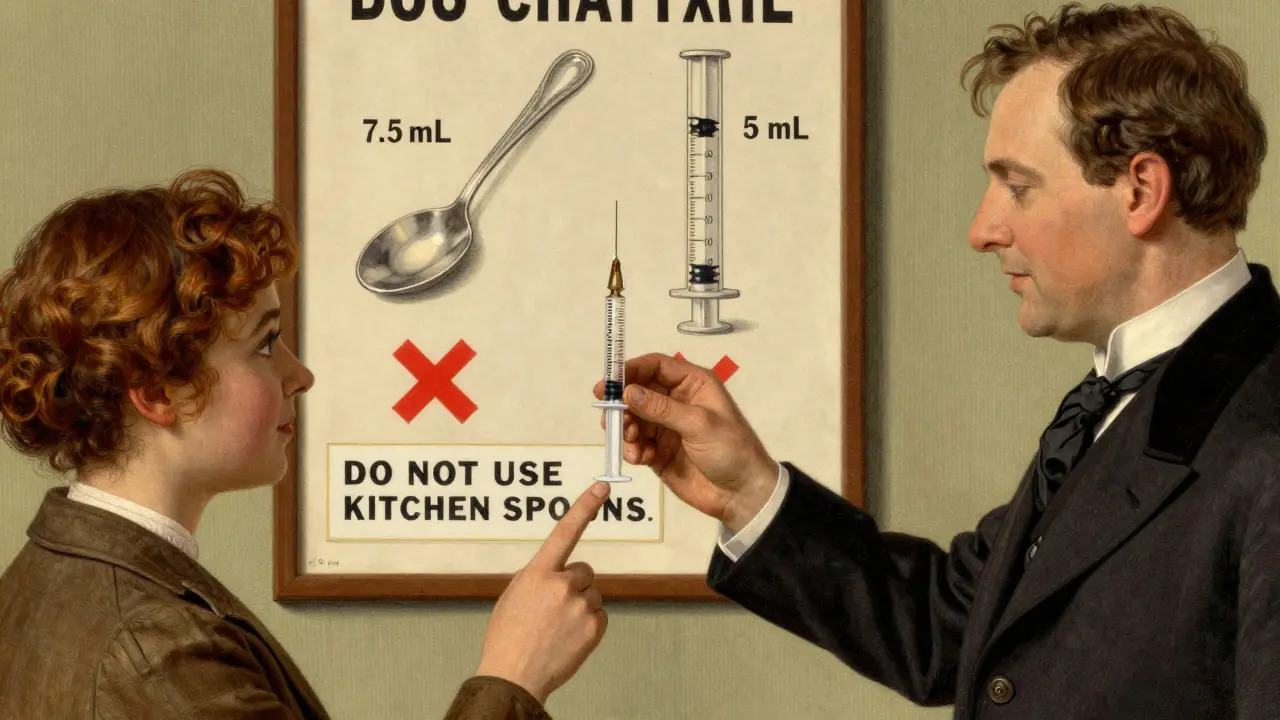
The biggest change in recent years is that milliliters (mL) are now the only approved unit on prescription labels. No more “teaspoon” or “tablespoon.” Why? Because household spoons are wildly unreliable. A teaspoon from your kitchen might hold anywhere from 2.5 mL to 7.5 mL. A tablespoon? It can range from 5 mL to 20 mL. That’s a 200% difference. One spoon could give your child half the dose. Another could give them triple.The FDA and the National Council for Prescription Drug Programs (NCPDP) made this rule for a reason. A 2017 study in the Journal of Patient Safety found that using mL instead of teaspoons reduced dosing errors by over 50%. If your label still says “1 tsp,” ask the pharmacist to rewrite it in mL. By law, they’re required to do it.
Here’s the exact conversion you need to remember:
- 1 mL = 1 milliliter
- 2.5 mL = 1/2 teaspoon
- 5 mL = 1 teaspoon
- 7.5 mL = 1/2 tablespoon
- 15 mL = 1 tablespoon
But don’t use spoons - ever. Even if the label says “1 tsp,” use the measuring device that came with the medicine. That’s the only tool that’s accurate.
How to Use the Measuring Device
The bottle should come with a syringe, cup, or dropper. This is your only trusted tool. Never use a kitchen spoon, a shot glass, or a medicine cup from a different bottle.Look at the device. It should have clear markings in mL. Some have lines for 0.5 mL, 1 mL, 2 mL, up to 10 mL or more. If the dose is 2.5 mL, fill it to the line between 2 and 3. Don’t guess. If the line isn’t clear, ask the pharmacist for a new device. Most pharmacies will give you a free, calibrated syringe on request.
Important: Always hold the device at eye level when measuring. If you look down at it, the liquid will appear higher than it is. That’s called parallax error - and it’s why so many people give too much. Place the device on a flat surface, bend down, and match the top of the liquid to the line.
Some devices have markings for both mL and teaspoons. Ignore the teaspoon side. Rely only on the mL numbers. Even if the cup says “1 tsp = 5 mL,” your brain might still default to “teaspoon.” Stick to mL.
Watch Out for Decimal Points and Trailing Zeros
A small mistake with a decimal point can be deadly. Here’s what you must know:- Always write or read doses with a leading zero: 0.5 mL - never .5 mL.
- Never write or read doses with a trailing zero: 5 mL - never 5.0 mL.
Why? Because if a doctor writes “.5 mL,” someone might misread it as “5 mL.” That’s a tenfold overdose. If a label says “5.0 mL,” someone might think it’s a mistake and round it down to 5 mL - but that’s not the issue. The real danger is when handwritten prescriptions are misread. The FDA found that eliminating trailing zeros cuts 10-fold dosing errors by 47%.
Always double-check the numbers. If the label says “0.8 mL,” that’s less than one-fifth of a teaspoon. It’s a tiny amount. Use a syringe. If it says “10 mL,” that’s two full teaspoons - but again, don’t use teaspoons. Use the syringe.
Don’t Confuse Concentration With Total Volume
This is the most common mistake parents make. You see a bottle labeled “500 mL.” You think, “That’s the dose.” It’s not. That’s the total amount in the bottle. The dose is written elsewhere - in the concentration line.Example: A bottle says “500 mL” total volume. The concentration says “240 mg / 5 mL.” The dosage says “Take 10 mL twice daily.”
- Total volume: 500 mL - how much medicine you have
- Concentration: 240 mg per 5 mL - how strong the medicine is
- Dose: 10 mL - how much to give each time
If you give 500 mL, you’ll overdose badly. If you give 10 mL, you’re giving 480 mg of medicine (because 240 mg x 2 = 480 mg). That’s correct. But only if you understand the difference.
Always ask yourself: “Is this number the total in the bottle, or the amount I’m supposed to give?” If you’re unsure, call the pharmacy. Don’t guess.
What If the Label Doesn’t Match the Device?
Sometimes, the label says “Give 1.2 mL,” but the syringe only has markings for 1 mL and 1.5 mL. What now?First, don’t round up or down unless the pharmacist tells you to. If the dose is 1.2 mL, and your syringe only goes to 1 mL, ask for a finer syringe. Many pharmacies carry 1 mL syringes with 0.1 mL markings - perfect for precise doses.
If you can’t get one, call the pharmacy. They can adjust the dose to something measurable - like 1.0 mL or 1.5 mL - if it’s safe. Never wing it. A 0.2 mL difference might seem small, but for a baby, it matters.
Also, check the expiration date. Liquid medicines can lose strength or grow bacteria after they expire. Most last 14-30 days after opening, unless the label says otherwise. If it’s cloudy, smells bad, or has particles - throw it out.

Teach-Back: The Best Way to Avoid Mistakes
Pharmacists are trained to explain how to use liquid medicine. But they’re busy. Don’t just nod and leave. Use the “teach-back” method.After they explain the dose, say: “Can I show you how I’ll give this?” Then, pick up the syringe and measure the dose out loud: “The label says 2.5 mL. I’m filling the syringe to the 2.5 line. That’s half of 5 mL. I’ll give this twice a day.”
Studies show this reduces errors by 63%. It’s not about being “stupid” or “forgetful.” It’s about making sure your brain really understands. If the pharmacist smiles and says, “Perfect,” you’re good to go.
What to Do If You Made a Mistake
If you gave the wrong dose - even once - call your pharmacist or doctor immediately. Don’t wait. Don’t feel guilty. Mistakes happen. The goal is to fix it fast.If you gave too much: Watch for drowsiness, vomiting, trouble breathing, or unusual behavior. Call poison control at 1-800-222-1222 (U.S.) or your local emergency number.
If you gave too little: Don’t double the next dose. Just give the correct dose at the next scheduled time. Missing one dose is safer than overdosing.
Keep a log. Write down each dose you give - time, amount, and date. This helps you spot patterns and helps doctors if something goes wrong.
What’s Changing in 2025?
New rules are coming. By 2025, the FDA wants all liquid medicine labels to include a small picture showing how to measure the dose - like a syringe with a line at 5 mL. Some pharmacies are already testing QR codes on labels that link to short videos showing proper use.Also, most major chains - CVS, Walgreens, Rite Aid - now automatically include a free measuring syringe with every liquid prescription. Independent pharmacies are catching up, but slower. If yours doesn’t give you one, ask. They’re required to provide it.
And if you’re caring for a child under 12 - which is 75% of all liquid prescriptions - ask your pediatrician to review the label during your next visit. Many clinics now include a quick “dose check” as part of routine care.
Medication safety isn’t about being perfect. It’s about being careful. One extra minute reading the label can save a hospital visit. Use mL. Use the right tool. Double-check. And never be afraid to ask.”
Can I use a kitchen spoon to measure liquid medicine if I don’t have the measuring cup?
No. Household spoons vary too much in size - a teaspoon can hold anywhere from 2.5 mL to 7.5 mL. Even if you think you know how much your spoon holds, it’s not safe. Always use the syringe, cup, or dropper that came with the medicine. If you lost it, call your pharmacy. They’ll give you a new one for free.
What does ‘240 mg/5 mL’ mean on the label?
It means every 5 milliliters of the liquid contains 240 milligrams of the active drug. If your dose is 10 mL, you’re getting 480 mg total (240 mg x 2). If your dose is 2.5 mL, you’re getting 120 mg (half of 240 mg). Always calculate based on the concentration - never the total bottle size.
Why do some labels say ‘0.5 mL’ and others say ‘.5 mL’?
Proper labeling always uses a leading zero: ‘0.5 mL.’ Labels that say ‘.5 mL’ are outdated or incorrectly printed. The FDA requires leading zeros because ‘.5 mL’ can be mistaken for ‘5 mL’ - a tenfold overdose. If you see ‘.5 mL,’ ask the pharmacist to confirm the dose and get a corrected label.
Is it safe to mix liquid medicine with juice or food to make it easier to take?
Only if the pharmacist says yes. Some medicines lose strength when mixed with food or drinks. Others change how they’re absorbed. Always ask before mixing. If approved, use the full amount of liquid - don’t pour out half the juice after giving the dose. Measure the medicine separately, then mix it in the full serving.
What should I do if the dose changes but the label hasn’t been updated?
Never guess. If your doctor changed the dose but the bottle label still says the old amount, call the pharmacy immediately. They must print a new label with the correct dose. Do not rely on memory or a note from your doctor. The label is the official instruction. If the pharmacy won’t update it, go to another one - your safety comes first.






Brady K.
Let’s be real - if you’re still using a goddamn kitchen spoon to measure liquid meds, you’re one typo away from a pediatric ICU visit. The FDA didn’t outlaw teaspoons because they hated your grandma’s recipe book. They did it because people like you think ‘a spoonful’ means something consistent. Spoiler: it doesn’t. 2.5 mL? 7.5 mL? That’s not a measurement - that’s Russian roulette with Tylenol. Use the syringe. Or don’t. But don’t come crying when your kid’s pupils turn into dinner plates.
Kayla Kliphardt
I read this whole thing twice because I’m terrified of messing up my daughter’s dose. I always use the syringe, but I still double-check the concentration every time. I didn’t realize how easy it is to confuse total volume with dose - I thought the 118 mL bottle meant I was giving her 118 mL. My stomach dropped. Thank you for explaining it so clearly. I’m printing this out and taping it to the fridge.
John Chapman
YESSSS 😍🙌 This is the kind of post that saves lives. I used to wing it with a spoon until my niece almost went to the ER. Now I keep 3 syringes in the medicine cabinet - one for each kid, labeled. Pharmacies give them for free? SIGN ME UP. If you’re reading this and still using a teaspoon - stop. Right now. Go call your pharmacy. I’ll wait. 💉❤️
Chandreson Chandreas
Man… in India, we still get labels with ‘teaspoon’ printed in tiny letters next to mL. No one pays attention. My aunt once gave my cousin 3 tsp of amoxicillin thinking it was ‘normal’ - turned out it was 15 mL, not 5. Kid was drowsy for 12 hours. We didn’t know any better. This guide? It’s not just useful - it’s a cultural shift waiting to happen. Someone needs to translate this into Hindi, Tamil, Bengali… and hand it out at every pharmacy. 🙏
Darren Pearson
While the intent of this article is laudable, one must acknowledge the inherent epistemological limitations of relying solely on pharmaceutical labeling as an epistemic authority. The ontological status of the ‘concentration’ metric is contingent upon the integrity of the compounding process, which remains largely unregulated at the state level. Furthermore, the implicit assumption that laypersons possess the requisite numeracy to interpret mg/mL ratios with precision is, frankly, a form of epistemic paternalism. A more robust solution would involve mandatory standardized visual-auditory aids integrated into the packaging ecosystem - not merely QR codes, which presuppose technological literacy.
Stewart Smith
Darren over there just wrote a 300-word thesis on ‘epistemic paternalism’… while I’m over here holding a syringe with 0.8 mL of medicine, sweating because I forgot to bend down to eye level. 😅 Honestly? I don’t care if it’s ‘paternalistic’ - I care that my kid doesn’t turn into a human popsicle from an overdose. Thanks for the no-BS guide. I’m printing it. And yes, I’m using the syringe. Even if it’s 3 AM and I’m half-asleep.
Retha Dungga
so like… if you give too much its bad right? and if you give too little its also bad? but dont double the next one? so what do you do?? like just wait?? and also why do they make it so hard?? why cant it just be 1 spoon?? 😭
Jenny Salmingo
I’m from the Philippines and my mom used to measure medicine with a spoon because she didn’t know better. Now I’m the one giving meds to my nephew, and I use the syringe every time. I even show my mom how - she says, ‘Why so much fuss?’ But I just smile and say, ‘Better safe than sorry.’ Simple? Yes. Important? Absolutely. ❤️