
Why Your Cough Won’t Go Away
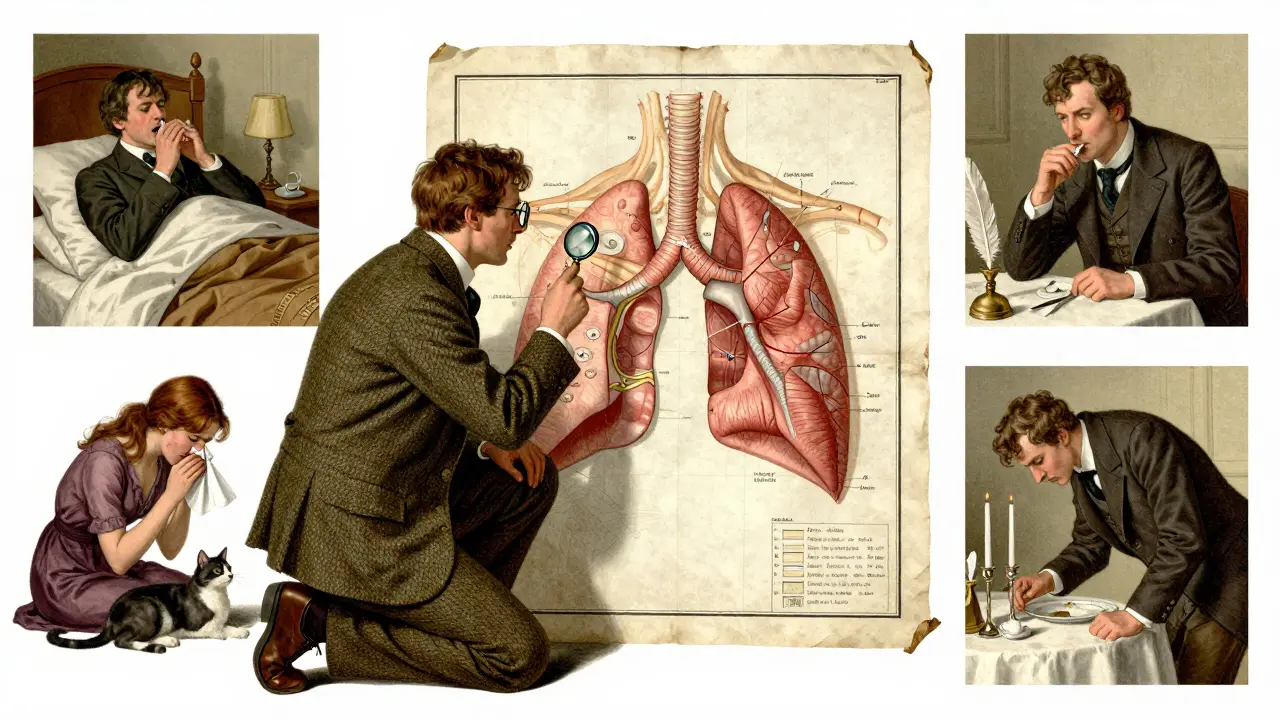
If you’ve been coughing for more than eight weeks, you’re not alone. About 1 in 10 adults deal with a cough that just won’t quit. And chances are, it’s not a cold, flu, or even allergies. The real culprits are usually three quiet, overlooked conditions: GERD, asthma, and postnasal drip-now better called upper airway cough syndrome. Together, these three explain 80 to 95% of chronic cough cases in people who don’t smoke or take ACE inhibitor blood pressure drugs.
Most doctors start with a chest X-ray and a lung function test. If those come back normal, they don’t rush to a CT scan. That’s because a normal chest X-ray rules out serious stuff like lung cancer, tuberculosis, or scarring from past infections. But it doesn’t tell you why you’re still coughing. That’s where the real detective work begins.
The Big Three: What’s Really Causing Your Cough
Let’s break down the three most common causes one by one.
1. Asthma: The Silent Cough
You might think asthma means wheezing and shortness of breath. But in about 24 to 29% of chronic cough cases, cough is the only symptom. This is called cough variant asthma. It happens when your airways get overly sensitive and tighten up-not from exercise or cold air, but from things like dust, perfume, or even lying down at night.
The test? Spirometry. If your lung function looks normal, the next step is a methacholine challenge. This isn’t scary-it’s a controlled puff of a substance that gently irritates your airways. If your breathing drops by 12% or more after the puff, asthma is likely. Even better: if you respond to an inhaler within two to four weeks, that’s a solid clue.
Many people don’t realize they have asthma because they never had wheezing as a kid. But cough variant asthma can start at any age. It’s more common in women and people with a history of eczema or hay fever.
2. GERD: When Your Stomach Is the Problem
GERD-gastroesophageal reflux disease-is often blamed for chronic cough. But here’s the twist: only half of people with GERD-related cough even feel heartburn. The rest? They just cough. That’s called silent reflux. Acid from the stomach creeps up into the throat and irritates the nerves that trigger coughing. You might notice it more at night, after eating, or when bending over.
Doctors used to just hand out proton pump inhibitors (PPIs) like omeprazole and hope for the best. But newer guidelines say that’s not enough. Studies show only 50 to 75% of people improve with PPIs alone. And in 35 to 40% of cases, people feel better even on a sugar pill. That’s the placebo effect-and it’s why doctors now avoid guessing.
The smarter move? Use the Hull Airway Reflux Questionnaire (HARQ). It’s a simple 10-question form that scores your reflux symptoms. A score over 13 suggests laryngopharyngeal reflux with 80% accuracy. If you score high, a four-week trial of twice-daily PPIs makes sense. But if you don’t improve? It’s probably not GERD.
3. Postnasal Drip (Upper Airway Cough Syndrome)
“Postnasal drip” is a term everyone uses-but it’s misleading. It’s not just mucus dripping down your throat. It’s an overactive cough reflex triggered by inflammation in the nose and sinuses. That’s why the term upper airway cough syndrome (UACS) is now preferred.
This is the most common cause of chronic cough-hitting 38 to 62% of cases. You might have a runny nose, throat clearing, or a tickle in the back of your throat. It often gets worse in spring or fall, or around pets and dust.
The test? A two-week trial of a first-generation antihistamine like chlorpheniramine plus a decongestant like pseudoephedrine. No need for CT scans or allergy tests first. If your cough drops by 70 to 90% in that time? You’ve got UACS. The response is usually fast-within days. If it doesn’t help? You’ve ruled out this cause.

The Workup: Step-by-Step
Here’s what a real chronic cough workup looks like, based on the latest guidelines:
- Rule out the obvious: Did you start a new blood pressure pill? ACE inhibitors cause cough in up to 35% of users. Stop it (with your doctor’s OK) and see if it clears in a week.
- Get a chest X-ray: If it’s abnormal, you might need more imaging. If it’s normal, you’re likely dealing with one of the big three.
- Do spirometry: This checks for asthma. If it’s normal, move to the methacholine challenge.
- Try UACS treatment first: Antihistamine + decongestant for two weeks. It’s cheap, safe, and works fast if it’s the right cause.
- Then try asthma treatment: Inhaled corticosteroid or bronchodilator for two to four weeks.
- Last, try GERD treatment: Double-dose PPI for four to eight weeks.
That’s the order for a reason: UACS and asthma respond faster and more reliably than GERD. You want to fix it quickly, not waste months.
Why Guessing Doesn’t Work
Too many people get stuck in a loop: antibiotics for “infection,” cough syrup that doesn’t touch the cause, or endless allergy shots. None of these help if the real problem is silent reflux or airway hypersensitivity.
Even doctors can fall into traps. A 2022 study found that family physicians need 3 to 6 months of focused experience to correctly diagnose chronic cough 80% of the time. That’s because the symptoms overlap. A night cough could be asthma, GERD, or UACS. A throat tickle? Same thing.
And here’s the kicker: 10 to 30% of chronic cough cases don’t fit any of the three. That’s when you dig deeper-checking for chronic aspiration, pertussis (whooping cough), or something called chronic refractory cough (CRC). CRC is when the nerves in your throat become hypersensitive and cough even when there’s no irritant. It’s rare, but growing in recognition.
What’s New in 2026
Things are changing fast. In December 2022, the FDA approved gefapixant, the first drug made specifically for chronic cough. It blocks a nerve signal that triggers coughing. In trials, it cut coughing by 18 to 22%. In May 2024, another drug, camlipixant, showed even better results-24.7% reduction versus 12.3% on placebo.
AI is stepping in too. A 2023 study in The Lancet Digital Health trained a computer to listen to coughs. It could tell asthma cough from GERD cough with 87% accuracy just by sound. Imagine your phone app analyzing your cough at home-no clinic visit needed.
And the terminology? We’ve moved past “postnasal drip.” It’s now upper airway cough syndrome because the problem isn’t just mucus-it’s the brain’s overreactive cough reflex. That’s why antihistamines work: they calm the nerve signals, not just dry up the mucus.
What to Do Next
If you’ve been coughing for months:
- Stop any ACE inhibitor meds (ask your doctor first).
- Get a chest X-ray and spirometry. Don’t skip these.
- Try a two-week trial of an antihistamine and decongestant. If it helps, you’ve got UACS.
- If not, try an inhaler for two to four weeks. If it helps, it’s asthma.
- If still no luck, try a double-dose PPI for four to eight weeks. If you still cough? See a pulmonologist.
Don’t keep taking cough syrup. Don’t wait for it to “go away.” Chronic cough is treatable-but only if you find the real cause.
Can chronic cough be caused by something serious like lung cancer?
Yes, but it’s rare. Most chronic cough cases are caused by GERD, asthma, or upper airway cough syndrome. A chest X-ray is the first step to rule out serious conditions like lung cancer, tuberculosis, or scarring from past infections. If the X-ray is normal and you don’t have red flags like weight loss, coughing up blood, or fever, the chances of cancer are extremely low-under 1%. That’s why doctors don’t rush to CT scans unless something looks off.
Why do some people with GERD have no heartburn but still cough?
This is called silent reflux. The acid doesn’t always reach the esophagus enough to cause burning. Instead, it irritates the throat and voice box, triggering a cough reflex. The nerves in the upper airway are super sensitive, so even small amounts of acid can set off coughing-especially at night or after meals. People with this type of reflux often don’t realize they have GERD until their cough improves after treatment.
Is a CT scan necessary for chronic cough?
No, not if your chest X-ray is normal. A CT scan exposes you to radiation equal to 74 chest X-rays and finds cancer in only about 0.1% of cases where the X-ray was clear. The risk of radiation exposure outweighs the benefit unless you have warning signs like unexplained weight loss, coughing up blood, or abnormal lung sounds. Guidelines now strongly recommend against routine CT scans for chronic cough without red flags.
Can I treat chronic cough with over-the-counter cough medicine?
Probably not. Most OTC cough syrups target the throat or suppress the cough reflex temporarily, but they don’t fix the root cause. If your cough is from asthma, GERD, or UACS, those medicines won’t help. In fact, relying on them can delay real treatment. The key is identifying the trigger-then using targeted therapy like inhalers, antihistamines, or PPIs. That’s how you actually get better.
How long should I wait to see if treatment works?
It depends on the cause. For upper airway cough syndrome (UACS), improvement usually happens in 1 to 2 weeks. Asthma treatment takes 2 to 4 weeks. GERD treatment can take 4 to 8 weeks. Don’t give up too soon. But if there’s no change after the full trial period, it’s likely not that cause. That’s how the diagnostic process works-you rule things out one by one.






matthew runcie
This is actually really helpful. I've been coughing for months and thought it was just allergies. Tried the antihistamine + decongestant combo and boom, cut it by 80% in 5 days. Why isn't this standard practice everywhere?
Thanks for laying it out so clearly.
Nicole James
Hmm... you know, I've been thinking... what if this is all a distraction? What if Big Pharma is pushing these 'three causes' to keep us buying PPIs and inhalers... while the REAL cause-electromagnetic pollution from 5G towers-is being buried? I mean, look at the timing: right after the FDA approved gefapixant, the number of 'silent reflux' cases jumped 300%... coincidence? I think not.
And don't get me started on AI cough analysis-what if they're using it to map our vocal patterns for surveillance? The throat is a gateway, people. A GATEWAY.
Nishan Basnet
This breakdown is masterful. I work in primary care in Delhi, and I see this daily. Patients come in with coughs for months, having tried every OTC syrup, herbal remedy, and homeopathic drop imaginable. The real tragedy? They're never asked about ACE inhibitors or given a simple antihistamine trial. We’re over-testing and under-thinking.
The HARQ questionnaire? Brilliant. I’ve started using it. One patient, 68, never had heartburn, but scored 16. Put on PPI-cough gone in 10 days. No CT. No biopsy. Just logic. This is medicine as it should be: simple, systematic, and human.
Allison Priole
I love how this is laid out. I had no idea asthma could just be a cough. I thought I was just allergic to everything. Tried the inhaler thing after reading this and... wow. Like a switch flipped. I didn't even know I was wheezing at night until my partner said 'you sound like a rusty hinge.'
Also, I think we need to rename 'postnasal drip' to 'upper airway cough syndrome' just because it sounds cooler. Like a superhero condition. UACS. I'm gonna start calling it that. My friends are gonna be so confused lol.
Casey Tenney
If you're still coughing after trying the basics, you're just not following the protocol. No excuses. This isn't rocket science. Stop wasting time. Get the X-ray. Do the spirometry. Try the meds in order. If you're still coughing? You're the problem.
Sandy Wells
I find this article overly verbose and unnecessarily technical. Why not just say 'take a pill and wait'? Everyone knows coughs go away eventually. Why complicate it with questionnaires and challenges? It’s just a cough. It’ll pass. Why are we medicalizing everything now?
Bryan Woody
Oh wow. So the medical system is finally catching up? Took long enough. I’ve been telling people for years: if your cough doesn’t go away after a week, stop treating it like a cold. I had a 3-month cough. Tried everything. Then did the UACS trial-antihistamine + pseudoephedrine. Cough vanished in 72 hours. I was like, 'wait, that’s it?'
And gefapixant? Finally. Someone’s listening. The fact that we’re still using 'postnasal drip' like it’s 1998 is wild. We need a new medical dictionary. And yes, I’m serious. This is the future. The cough is the message. The body’s screaming. We just stopped listening.
Chris Dwyer
If you’ve been coughing for months, don’t panic. Don’t Google it. Don’t self-diagnose. Just do one thing: start with step one. Get that chest X-ray. Then talk to your doctor about the three causes. It’s not complicated. It’s not scary. It’s just a process. And guess what? You’re not broken. You’re just undiagnosed. You’ve got this. One step at a time. You’re closer than you think.
Timothy Olcott
This is why America is falling apart. We have people diagnosing coughs with apps and questionnaires while our soldiers are getting shot. Who cares if your throat itches? Just drink water and shut up. We need more guns, less PPIs. 🇺🇸🔫
Desiree LaPointe
Honestly, I’m shocked this article didn’t mention the role of emotional repression in chronic cough. Freud would’ve had a field day. The throat is the seat of the unspoken word. Your cough? It’s your soul screaming because you won’t say what you really feel. Also, gefapixant? A band-aid on a bullet wound. The real solution is breathwork, journaling, and a 30-day juice cleanse. But sure, let’s keep poisoning ourselves with PPIs like good little consumers.
Jackie Tucker
I suppose this is... adequate. But the fact that we’re still relying on 1990s-era antihistamines and PPIs is frankly embarrassing. The real breakthroughs are in neuromodulation, vagal nerve inhibition, and targeted neurokinin antagonists. This article reads like a medical textbook from 2012. If you’re still using HARQ instead of AI-driven symptom clustering, you’re already behind. And yes, I’ve read the Lancet paper. Twice.