
What Is Triple-Negative Breast Cancer?
Triple-negative breast cancer (TNBC) is a type of breast cancer that doesn’t have estrogen receptors, progesterone receptors, or too much HER2 protein. That means the usual hormone therapies or HER2-targeted drugs won’t work. It makes up about 10% to 15% of all breast cancers, but it’s one of the most aggressive forms. TNBC tends to grow fast, spread earlier, and come back more often than other types-especially within the first three to five years after diagnosis.
Because it lacks the typical targets, treatment has long relied on chemotherapy. But that’s changing. New research is turning TNBC from a one-size-fits-all problem into a group of subtypes that respond to different tools. Scientists now know that not all TNBC is the same. Some tumors have BRCA mutations, others express PD-L1, and some have high levels of certain proteins that can be hit with new drugs. This is why testing your tumor isn’t just helpful-it’s essential.
Standard Treatment: Chemotherapy Still Leads, But It’s Evolving
For early-stage TNBC, the standard approach starts with neoadjuvant chemotherapy-meaning chemo before surgery. The goal? Shrink the tumor so it’s easier to remove and increase the chance of a complete response. Common regimens include anthracyclines like doxorubicin and taxanes like paclitaxel. Platinum drugs like carboplatin are often added, especially for younger patients or those with BRCA mutations.
Why platinum? Because TNBC cells with BRCA mutations have trouble repairing DNA damage. Platinum drugs break DNA strands, and without BRCA to fix them, the cancer cells die. Studies show adding carboplatin can boost the chance of a pathologic complete response (pCR)-meaning no cancer left in the breast or lymph nodes after treatment-from around 40% to over 50% in some cases.
But chemotherapy isn’t gentle. Side effects like fatigue, nausea, hair loss, and low blood counts are common. And even when it works, many patients still relapse. That’s why doctors are looking for ways to make chemo more effective without making it harder to tolerate.
Immunotherapy: Turning the Body’s Defenses Against Cancer
For TNBC patients whose tumors test positive for PD-L1 (about 40% of metastatic cases), immunotherapy has become a game-changer. Pembrolizumab (Keytruda) and atezolizumab (Tecentriq) are checkpoint inhibitors that block signals cancer uses to hide from immune cells. When combined with chemotherapy, they help the immune system find and kill cancer cells more effectively.
In the KEYNOTE-522 trial, adding pembrolizumab to chemo before surgery raised the pCR rate to 64.8% in PD-L1-positive patients, compared to 44.1% with chemo alone. For metastatic TNBC, the IMpassion130 trial showed that atezolizumab plus nab-paclitaxel extended progression-free survival to 7.2 months versus 5.5 months with chemo alone.
But here’s the catch: if your tumor is PD-L1 negative, immunotherapy adds little benefit. That’s why testing is non-negotiable. The 22C3 pharmDx test is used to determine PD-L1 status before starting treatment. And while immunotherapy helps some, it doesn’t work for everyone-yet.

PARP Inhibitors: Targeting BRCA Mutations
About 15% to 20% of TNBC patients carry a germline BRCA1 or BRCA2 mutation. These mutations damage the cell’s ability to repair broken DNA. PARP inhibitors like olaparib (Lynparza) and talazoparib (Talzenna) exploit this weakness. They block another DNA repair pathway, causing cancer cells to collapse under too much damage.
The OlympiAD trial showed that for metastatic TNBC with BRCA mutations, olaparib improved progression-free survival by 7.8 months compared to standard chemotherapy. Talazoparib showed similar results. These drugs are now standard for this subgroup-taken as pills, with fewer side effects than chemo.
But not all BRCA mutations are the same. Some are inherited, others develop over time. Testing is done through a blood or saliva sample. If you have TNBC, your doctor should offer BRCA testing at diagnosis, no matter your age or family history. Even without a family history, up to half of BRCA-positive TNBC patients have no known relatives with cancer.
Newer Drugs: Antibody-Drug Conjugates Are Changing the Game
Antibody-drug conjugates (ADCs) are like smart bombs. They deliver powerful chemo directly to cancer cells by attaching it to an antibody that locks onto specific proteins on the tumor surface.
Sacituzumab govitecan (Trodelvy) targets Trop-2, a protein found on most TNBC cells. In the ASCENT trial, it doubled the median overall survival compared to standard chemo in patients who had already tried two or more prior treatments. Response rates were 35%, and the median duration of response lasted 5.6 months. It’s now approved for metastatic TNBC after prior chemo.
Another ADC, trastuzumab deruxtecan (Enhertu), was originally made for HER2-positive breast cancer. But it works even when HER2 is only slightly present-what’s called HER2-low. In the DESTINY-Breast04 trial, it showed a 37% response rate in HER2-low TNBC, a group previously thought to have no targeted options.
These drugs aren’t perfect. Sacituzumab can cause severe neutropenia (low white blood cells) in 61% of patients and diarrhea in 37%. But for people who’ve run out of options, they offer real hope.
Breaking New Ground: Personalized Vaccines and Dual-Target Therapies
One of the most exciting advances is coming from Houston Methodist Hospital. Researchers there are developing personalized neoantigen vaccines made from a patient’s own tumor DNA. After sequencing the tumor, they design a vaccine targeting unique mutations found only in that person’s cancer. The vaccine is made in-house within six weeks and given with pembrolizumab to boost immune response.
In early trials, 78% of patients showed immune activation against their cancer. This isn’t just about treating existing tumors-it’s about preventing recurrence. If it works in larger trials, this could become the first true preventive therapy for TNBC after surgery.
Another promising direction is dual-target therapy. Instead of hitting one pathway, scientists are combining drugs to block two at once. For example, pairing a CDK4/6 inhibitor with a PI3K inhibitor stops cancer from escaping through backup routes. Preclinical models show these combinations can inhibit tumor growth by 68%, compared to 32% with single agents.
Still, most of these are in early trials. Toxicity is a concern. But the potential is huge: turning TNBC from a fast-moving threat into a manageable, even preventable, condition.
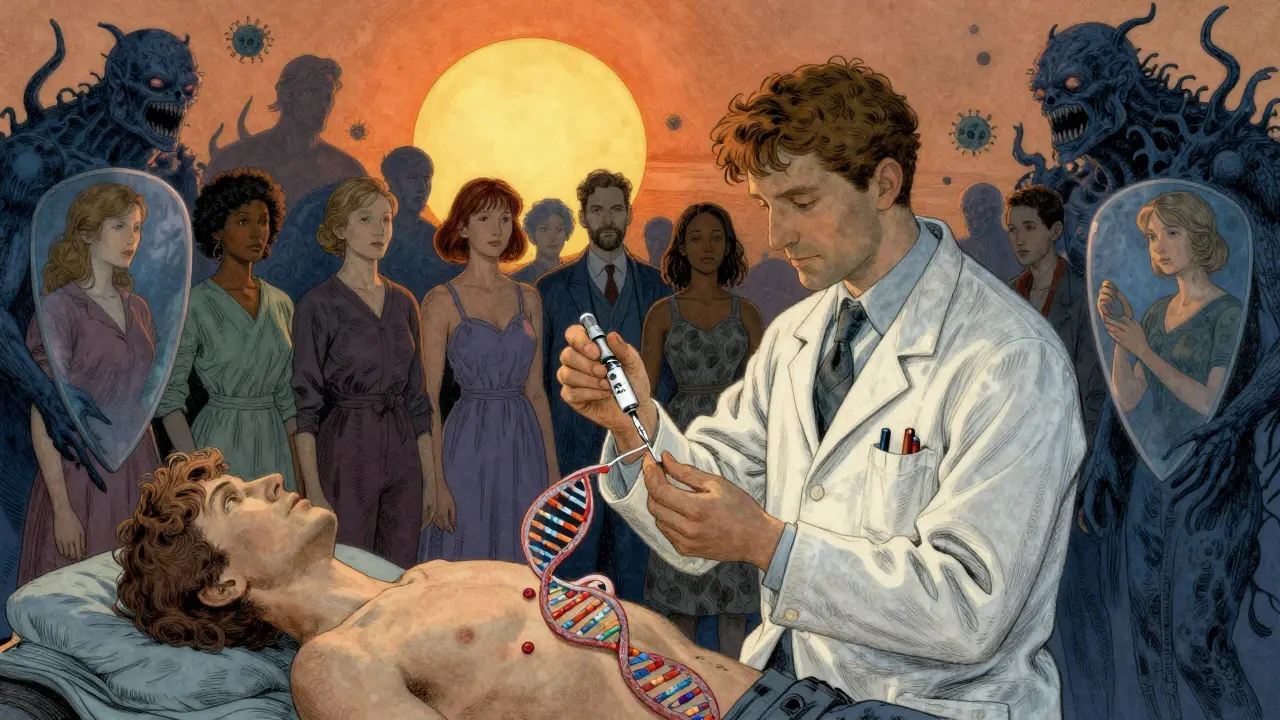
What’s Changing Fast: Treatment Timing and Reduced Toxicity
A groundbreaking study from UT Southwestern Medical Center, published in January 2025, flipped the script on how TNBC is treated. Instead of starting with chemo and saving radiation for last, they gave radiation at the very beginning-before any chemo or immunotherapy.
The result? A 59% pathologic complete response rate, matching the best results from KEYNOTE-522. But here’s the kicker: serious side effects dropped from 82% to just 41%. They used only two doses of pembrolizumab instead of the usual 16. The whole treatment cycle-radiation, two immunotherapy doses, chemo, surgery-was done in 12 weeks instead of 18 to 24.
This isn’t just about saving time. It’s about reducing damage to the body. Patients are less likely to need blood transfusions, hospitalizations, or long-term fatigue. The NCCN guidelines are expected to update in May 2026 to reflect this approach. If adopted widely, it could become the new standard.
What’s Still a Challenge?
Despite all the progress, TNBC remains tough. Five-year survival for metastatic TNBC is still only 12% to 15%, compared to 28% for other breast cancer types. Many patients still relapse after treatment. Resistance develops. Tumors are genetically messy-different parts of the same tumor can behave differently.
Access is another issue. Biomarker testing, new drugs, and clinical trials are often only available in major cancer centers. In low- and middle-income countries, fewer than 40% of patients get tested for BRCA or PD-L1. Even in the U.S., not all hospitals have the tools or expertise to offer these advanced treatments.
And while new drugs are coming, they’re expensive. Sacituzumab govitecan costs over $150,000 a year. Insurance coverage varies. Patients often need help navigating financial aid programs.
What Should You Do Next?
If you’ve been diagnosed with TNBC, here’s what matters most:
- Get full biomarker testing-BRCA status, PD-L1, and ideally, tumor mutational burden and HRD.
- Ask about clinical trials-especially if you’re early-stage or have relapsed. Many of the most promising treatments are only available through trials.
- Seek care at a comprehensive cancer center-they have tumor boards that review complex cases and access to the latest drugs and protocols.
- Don’t assume chemo is the only option-your treatment plan should be based on your tumor’s biology, not just the stage.
Every TNBC case is different. What works for one person might not work for another. But with better testing, smarter combinations, and new tools like vaccines and ADCs, the future is no longer just about surviving TNBC-it’s about outliving it.
Is triple-negative breast cancer curable?
Early-stage triple-negative breast cancer can be cured in many cases, especially if it responds well to neoadjuvant chemotherapy and surgery. A pathologic complete response (pCR)-no remaining cancer after treatment-is linked to long-term survival. But for metastatic TNBC, a cure is rare. Treatment focuses on controlling the disease and extending life. New therapies like immunotherapy, PARP inhibitors, and ADCs are improving outcomes, but long-term survival remains a challenge.
What is the survival rate for triple-negative breast cancer?
For early-stage TNBC, the 5-year survival rate is around 77% if the cancer hasn’t spread beyond the breast and nearby lymph nodes. If it has spread to distant organs (metastatic), the 5-year survival drops to 12%-15%. These numbers are improving with newer treatments, but TNBC still has the lowest survival rate among breast cancer subtypes.
Do I need genetic testing if I have triple-negative breast cancer?
Yes. All patients with TNBC should be offered germline BRCA1/2 testing, regardless of age or family history. About 15%-20% of TNBC cases are linked to inherited BRCA mutations. Finding a mutation can change your treatment plan-PARP inhibitors may be an option-and can also help your family members understand their own cancer risk.
Can I avoid chemotherapy for triple-negative breast cancer?
For most patients, chemotherapy is still the backbone of treatment, especially in early-stage disease. But new approaches are reducing its role. Immunotherapy combined with chemo has improved outcomes without replacing chemo entirely. In some cases, like those with BRCA mutations, PARP inhibitors may be used after chemo. Emerging strategies, like the UT Southwestern protocol, reduce chemo exposure by using radiation early and limiting immunotherapy doses. But avoiding chemo completely is not yet possible for most.
Are there any new drugs for triple-negative breast cancer in 2026?
Yes. Several new drugs are now approved or nearing approval. Sacituzumab govitecan and trastuzumab deruxtecan are already in use for advanced cases. In 2025-2026, datopotamab deruxtecan (a TROP-2 ADC) showed strong results in phase III trials. Personalized neoantigen vaccines are in early trials and may become available by 2028. Dual-target therapies like CDK12/PARP inhibitors are also entering clinical testing. The field is moving fast toward precision medicine.







Russ Kelemen
This is one of those posts that makes you realize medicine isn't just about drugs anymore-it's about listening to the tumor itself. I used to think chemo was the only way, but seeing how much we've learned about subtypes... it's like the body's been whispering clues all along, and we're finally learning to hear them.
What blows my mind is how much of this was impossible ten years ago. We're not just treating cancer-we're outsmarting it, one mutation at a time. And honestly? That gives me hope even when the stats feel heavy.
April Allen
The shift from population-based to biomarker-driven treatment is paradigm-shifting. TNBC isn't a monolith-it's a constellation of molecular phenotypes with distinct vulnerabilities. PD-L1 positivity, HRD status, BRCA germline variants, Trop-2 overexpression-each defines a therapeutic axis. The ASCENT and OlympiAD trials aren't just incremental; they're foundational. And the emerging ADCs? They're the first class of agents to achieve meaningful survival gains in heavily pretreated metastatic TNBC without systemic toxicity proportional to efficacy.
Kathleen Riley
It is imperative to acknowledge that the current paradigm of precision oncology, while intellectually compelling, remains inaccessible to the majority of the global population. The exorbitant cost of antibody-drug conjugates, the logistical burden of genomic sequencing infrastructure, and the geographic concentration of clinical trial sites constitute a systemic inequity that cannot be reconciled by scientific advancement alone. We must not confuse innovation with justice.
Beth Cooper
Okay but have you heard about the 2023 WHO memo that says all these 'new treatments' are just a cover for Big Pharma to sell more drugs? I read a guy on a forum who said his oncologist refused to give him radiation first because the 'protocol' was too new-turns out the hospital got paid by a drug company to stick with chemo-first. They're scared of the UT Southwestern data because it cuts their profits. That 59% pCR rate? Probably faked. They don't want you to know chemo isn't the only way.
Melissa Cogswell
Just wanted to say thank you for writing this. I was diagnosed last year and spent months feeling lost. This post helped me understand why my doctor pushed for BRCA testing even though no one in my family had cancer. I’m on olaparib now. Side effects are rough, but way better than chemo. I didn’t know PARP inhibitors existed until I read this.
Bobbi Van Riet
I’m a survivor of early-stage TNBC and I still think about this every day. What really stuck with me was how they said to ask about clinical trials-even if you feel like you're 'doing fine.' I didn’t think I qualified, but I ended up in a trial for a new ADC and it changed everything. Also, the part about not assuming chemo is the only option? That’s huge. I had a doctor tell me I had to do six rounds before surgery, but my tumor was shrinking fast, so we switched to a different combo. My oncologist listened. That’s the thing-your body talks, you just have to find someone who’ll listen.
And yeah, the cost thing? Real. I had to apply for six different patient assistance programs just to get my pills. But if you’re reading this and you’re scared? You’re not alone. We’re all just trying to outlive it.
Sazzy De
The radiation first thing is wild. I didn't even know that was a thing. Feels like we're finally unlearning the idea that more chemo = better. Less poison, same results? Sign me up.
Rohit Kumar
In India, we don't have access to most of this. BRCA testing? Only in three cities. Sacituzumab? Unaffordable. We still treat TNBC with old regimens because that's all we have. But I tell my patients: even if you can't get the latest drug, know your tumor. Demand the basic tests. PD-L1, BRCA-ask for them. Don't let them say 'it's not necessary.' You have the right to know. And if you're reading this from a place with no resources? Find someone who can help you write the letter. Someone always can.