
What Is Contact Allergens and Why It Matters
If your skin keeps breaking out in red, itchy patches-especially after touching something you’ve used for years-you’re not imagining it. This isn’t just dry skin or a bad reaction to soap. It could be allergic contact dermatitis, a delayed immune response triggered by everyday substances you never thought could hurt you. Unlike a sudden rash from a bee sting, this kind of reaction takes days to show up. That’s why it’s so easy to miss the link between your rash and that new watch strap, your favorite lotion, or even the metal in your earrings.
These triggers are called contact allergens. They’re not dangerous to most people, but for those sensitized, even tiny amounts can cause inflammation. The good news? You don’t have to guess what’s causing it. There’s a proven, reliable test called patch testing that can tell you exactly which substances are behind your flare-ups.
How Patch Testing Works
Patch testing is the gold standard for identifying allergic contact dermatitis. It’s not like a skin prick test you might get for pollen or peanuts. Those detect immediate reactions. Patch testing finds the slow-burning kind-type IV hypersensitivity-that shows up 48 to 96 hours later.
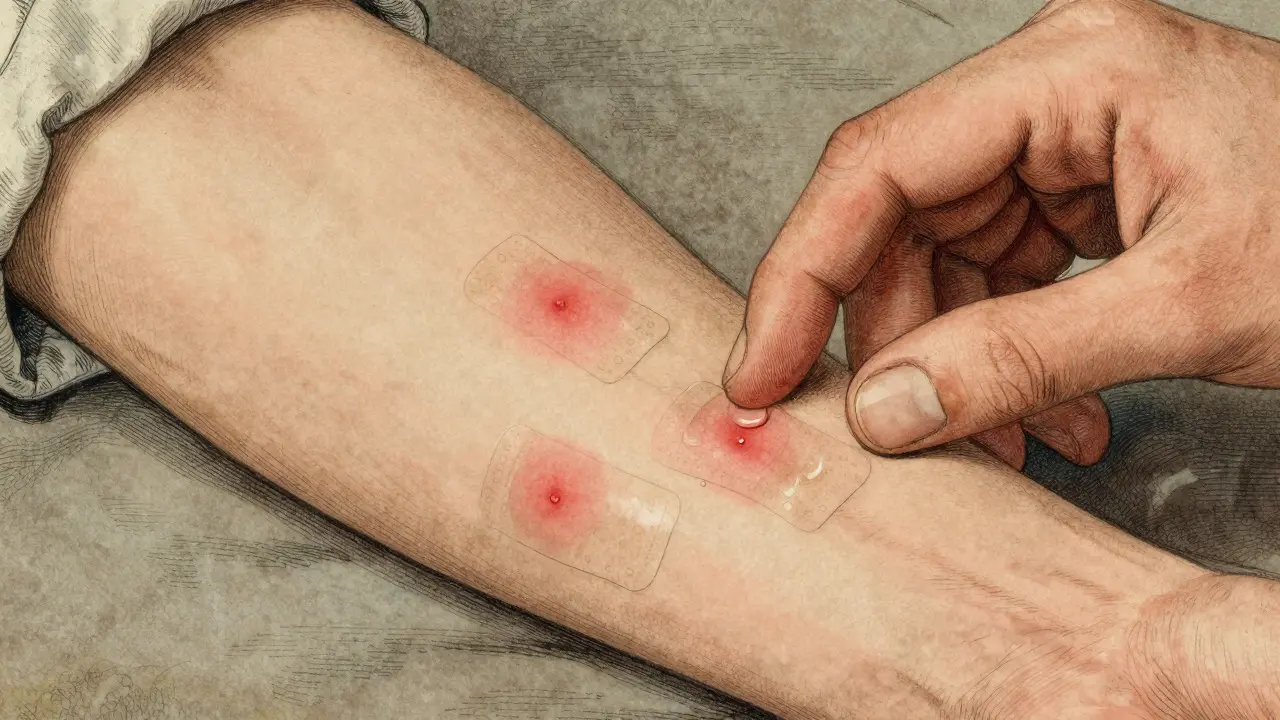
The process is simple but precise. Small amounts of common allergens are placed in tiny chambers, usually made of aluminum, and taped to your back. Between 30 and 100 different substances can be tested at once. These include things like nickel, fragrances, preservatives in cosmetics, and chemicals found in rubber or adhesives. The patches stay on for exactly 48 hours. You can’t get them wet, sweat heavily, or peel them off early-even if your skin itches. Moisture or movement can ruin the test.
Three visits are standard: one to apply the patches, one to remove them, and another two days later to check for reactions. The dermatologist looks for redness, swelling, or tiny blisters right under each patch. A positive result means your immune system recognizes that substance as a threat.
What Happens During and After the Test
Most people feel mild itching or discomfort under the patches, especially if they react. That’s normal. But if you remove the patches early, you risk getting a false negative. Even if your skin looks fine after 48 hours, the reaction might still develop by day 4 or 5. That’s why the final reading is so important.
Some people worry about the test making their rash worse. It doesn’t. The allergens are applied in very low concentrations, just enough to trigger a reaction in sensitized skin-not enough to cause serious damage. If your back is already inflamed, your dermatologist might use your arm or abdomen instead.
After the test, you’ll get a list of allergens you reacted to. This isn’t just for knowledge-it’s your roadmap to relief. Avoiding those substances can cut flare-ups by up to 80%. That means switching to fragrance-free products, choosing nickel-free jewelry, or asking your employer for safer gloves if you work with chemicals.
Common Contact Allergens You Might Be Exposed To
There are thousands of possible contact allergens, but a few show up again and again in patch tests. Here are the most common ones:
- Nickel: Found in jewelry, belt buckles, zippers, and even some coins. It’s the #1 cause of allergic contact dermatitis worldwide.
- Chromates: Used in cement, leather tanning, and some paints. Construction workers and mechanics often test positive.
- Formaldehyde and formaldehyde-releasing preservatives: Hidden in shampoos, lotions, makeup, and even some baby wipes.
- Neomycin and other antibiotics: Common in over-the-counter creams like Neosporin. Ironically, people use these to treat rashes-and end up causing them.
- Paraphenylenediamine (PPD): Found in hair dyes. Many people don’t realize they’re allergic until after coloring their hair.
- Fragrances: Both synthetic and natural (like tea tree oil or lavender) can trigger reactions. They’re in almost every scented product.
- Coconut diethanolamide: A foaming agent in soaps and shampoos that many people mistake for being gentle.
These aren’t just random chemicals. They’re in the products you use every day. That’s why patch testing is so powerful-it turns guesswork into clarity.
Patch Testing vs. Irritant Contact Dermatitis
Not every skin reaction is an allergy. In fact, most cases of contact dermatitis are caused by irritants, not allergens. Irritant contact dermatitis happens when something physically damages your skin-like bleach, detergent, or even too much handwashing. It doesn’t involve your immune system. It’s just chemical burn.
Here’s how to tell the difference:
- Allergic contact dermatitis: Starts as red, itchy patches that may blister. Usually appears 1-3 days after exposure. Only affects areas that touched the allergen. Can develop after years of using a product without issue.
- Irritant contact dermatitis: Hurts more than it itches. Looks dry, cracked, or raw. Often appears right after exposure. Common in people who wash hands frequently or work with solvents.
Patch testing only finds allergies. If your test comes back negative, your dermatologist will still help you figure out if irritants are the problem-and how to protect your skin.
What If the Test Is Negative?
A negative patch test doesn’t mean you’re off the hook. It just means the standard panel didn’t catch your trigger. There are over 5,000 known contact allergens, and most tests only cover 60-80 of the most common ones. If your rash keeps coming back, your doctor might suggest expanded testing.
Expanded panels include allergens tied to specific jobs: florists (get tested for chrysanthemum extract), dental workers (tested for mercury or acrylates), or hairdressers (tested for resorcinol). You can also bring in your own products-shampoo, lotion, even your favorite hand cream-to test them individually.
Another option is repeat open application testing (ROAT). You apply the suspect product to a small patch of skin on your forearm twice a day for 5-10 days. If your skin stays clear, you’re probably not allergic to it. If it turns red or itchy? That’s your culprit.

What You Can Do After Getting Results
Once you know your allergens, avoidance is key. But it’s not about living in fear. It’s about making smarter choices.
- Read labels. Look for terms like “fragrance-free,” “hypoallergenic,” or “nickel-tested.”
- Use barrier creams or gloves when handling chemicals, even if you’re not sure they’re a problem.
- Switch to metal-free jewelry. Titanium or surgical steel are safer options.
- Ask your pharmacist for preservative-free products. Many pharmacies stock lines designed for sensitive skin.
- Keep a symptom diary. Note what you touched before a flare-up. Patterns emerge over time.
Topical steroids can calm active rashes, and oral antihistamines help with itching-but they don’t fix the root cause. Only avoiding the allergen does.
Why Patch Testing Is Still the Best Option
There’s no blood test, no scanner, no app that can replace patch testing. It’s the only method that accurately detects delayed-type allergic reactions. Other tests might tell you you’re allergic to peanuts. Only patch testing can tell you why your wrist is red after wearing your smartwatch.
Major dermatology groups like the American Academy of Dermatology and DermNet NZ agree: patch testing is the most reliable diagnostic tool available. It’s been used for over 50 years and still hasn’t been surpassed.
Even with new products flooding the market-organic skincare, eco-friendly cleaners, vegan cosmetics-new allergens keep appearing. Patch testing evolves with them. The baseline panel is updated regularly to reflect what’s actually causing reactions today, not what did 20 years ago.
Final Thoughts: Knowledge Is Your Best Defense
If your skin keeps acting up, don’t just reach for more cream. Don’t assume it’s stress or dryness. You might be reacting to something you’ve used for years without issue. Patch testing gives you the power to stop guessing and start living without constant flare-ups.
It’s not a quick fix. It takes time, patience, and a little discomfort during the test. But the payoff? Clear skin, fewer doctor visits, and the confidence to choose products without fear.
You don’t have to live with itchy, irritated skin. With the right test and the right information, you can find out what’s really causing it-and finally put an end to the cycle.
Can I take antihistamines during patch testing?
Yes. Antihistamines do not interfere with patch testing because it detects type IV (delayed) hypersensitivity, not the type I reactions that antihistamines block. You can continue taking them for allergies, hives, or itching during the test.
How long do patch test results last?
Once you’re sensitized to an allergen, you usually stay allergic for life. Avoiding the substance prevents flare-ups, but reintroducing it-even years later-can trigger a reaction again. The test result doesn’t expire; your avoidance strategy does.
Can children get patch tested?
Yes, but it’s usually reserved for older children and teens with persistent, unexplained rashes. Younger kids often have irritant dermatitis from drooling, diapers, or frequent handwashing, which patch testing won’t detect. Dermatologists weigh the benefits against the challenge of keeping patches on small, active skin.
Is patch testing covered by insurance?
In most cases, yes-especially if you’ve tried other treatments without success and your dermatologist deems it medically necessary. Check with your provider, but in Australia and the U.S., it’s typically covered under dermatology or allergy services.
What if I react to something I can’t avoid?
Some allergens are unavoidable-like nickel in public door handles or chromates in concrete. In these cases, your dermatologist will help you reduce exposure: wearing gloves, using barrier creams, or choosing alternatives. Complete avoidance isn’t always possible, but smart management can reduce flare-ups significantly.






Ellie Norris
I got patch tested last year after my wrists turned into a red mess from my smartwatch. Turns out I’m allergic to nickel AND fragrance. Who knew? I switched to titanium bands and fragrance-free laundry soap and my skin hasn’t been this calm in years. Life-changing.
Marc Durocher
so i just googled 'why does my face itch after i wash my hands' and ended up here. honestly? this is the most useful thing i've read all week. thanks for not talking like a textbook.
larry keenan
The immunological mechanism underlying allergic contact dermatitis is classified as a Type IV hypersensitivity reaction, mediated by CD4+ T lymphocytes. This distinguishes it from IgE-mediated immediate hypersensitivity, which is pharmacologically antagonized by antihistamines. Patch testing remains the diagnostic modality of choice due to its high specificity and sensitivity in detecting delayed-type reactions.
Nick Flake
I used to think my skin was just 'sensitive'... until I realized I was allergic to my own shampoo. 🤯 Patch testing didn’t just fix my rash-it changed how I see the world. Every product has a story. Every ingredient, a silent whisper. Now I read labels like poetry. And yes, I cry sometimes. Not from sadness. From relief.
Akhona Myeki
In South Africa, we don’t have the luxury of fancy patch tests. We use traditional remedies and common sense. If your skin breaks out, stop using whatever you just bought. No need for 100 aluminum patches when your grandmother knew what worked. This is Western overcomplication.
Chinmoy Kumar
i never thought i'd be allergic to coconut oil... but after using it as a moisturizer for months, my arms looked like i'd been burned. patch test was a shock. now i use shea butter instead. weird how the 'natural' stuff can be the worst. thanks for sharing this, really helped me connect the dots.
Brett MacDonald
so like... if you're allergic to formaldehyde but your shampoo has it... are you just supposed to not wash your hair? or is this the universe's way of telling me to go bald?
Sandeep Kumar
Americans overthink everything. In India we just use neem soap and move on. Why pay for a test when your skin tells you? Also fragrances are for weak people. Real men use plain soap and don't cry about it.
Gary Mitts
I didn’t know I was allergic to my own moisturizer. Now I know. That’s all I needed.
Brittany Marioni
I just want to say-thank you-for including the part about coconut diethanolamide. I’ve been using 'gentle' cleansers for years, and I had no idea it was the culprit. I’m switching to a sulfate-free, fragrance-free, coconut-free option tomorrow. I’m already feeling calmer just thinking about it.
Monica Slypig
This is why American medicine is superior. In other countries, people still believe in 'natural cures' or 'energy balancing.' Here, we have science. We have aluminum patches. We have data. Don’t let anyone tell you otherwise.
Becky M.
I’m from the Midwest and I used to think my eczema was just from winter air. Then I got patch tested and found out I was allergic to my own hand soap. Turns out, 'natural' doesn’t mean safe. Now I use plain glycerin soap and I feel like a new person. Also, I started teaching my coworkers about patch testing. Small changes, big impact.
jay patel
i spent 8 years thinking my rash was stress-related. i even tried yoga, journaling, and cutting out dairy. turns out? it was the nickel in my cheap earrings and the preservative in my baby wipes. i cried when i saw the results. not because i was mad-because i finally understood. and now i know why my sister had the same rash for 15 years. we both wore the same cheap jewelry. we were both clueless. patch testing isn't just a test. it's a reunion with your own body.
Marc Durocher
I’m glad you mentioned the 'can’t avoid it' part. My job involves concrete. Chromates? Yeah. I’m not quitting construction. But now I wear nitrile gloves and wipe down my tools daily. Small wins. Still alive. Still not itching.