
How many times have you heard that you need to drink eight glasses of water a day? Or that chewing gum stays in your stomach for seven years? What about the idea that we only use 10% of our brains? These aren’t just harmless jokes-they’re myths that shape how people make decisions about their health. And when those myths stick, they can lead to bad choices, wasted money, or even real harm.
Why do health myths stick around?
Myths don’t survive because they’re true. They survive because they’re simple, repeatable, and fit into stories we already believe. Take the idea that sugar makes kids hyperactive. Parents swear they’ve seen it. A child eats a cupcake at a birthday party, then runs around like a maniac. But over 23 double-blind studies have shown no link between sugar and hyperactivity. So why does the myth persist? Because it’s easier to blame the candy than to admit kids are just kids. The sugar industry even helped keep this myth alive for decades through lobbying and funding biased research. The same thing happens with the head-heat myth. People think you lose most of your body heat through your head because it’s cold outside and your head feels cold. But your head is only about 7-10% of your total body surface. If you go outside without a hat, you’ll lose heat from your head-just like you would from your hands, feet, or any other uncovered part. The myth stuck because it’s memorable. It’s not science. It’s a shortcut our brains take.The eight-glass myth: where did it even come from?
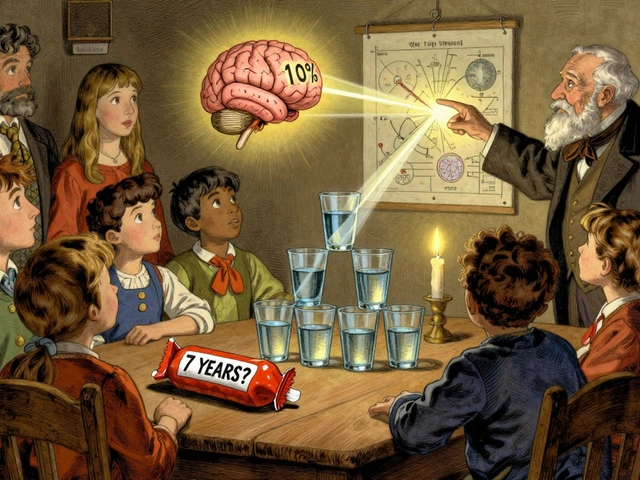
You’ve heard it since childhood: drink eight glasses of water a day. It’s on every health poster, every fitness app, every influencer’s morning routine. But here’s the truth: there’s no scientific basis for that number. Dr. Heinz Valtin, a kidney specialist at Dartmouth Medical School, reviewed decades of peer-reviewed research in 2002 and found zero evidence supporting the eight-glass rule. Where did it come from? A 1945 recommendation from the U.S. Food and Nutrition Board that said adults need about 2.5 liters of water daily-including water from food and other drinks. Somewhere along the way, the part about food and other beverages got dropped. Now we think we need to chug eight glasses of plain water, even when we’re eating soup, fruit, yogurt, or drinking tea. Your body is smarter than that. It tells you when it needs water: thirst. If you’re not thirsty, you’re probably fine. If you’re sweating a lot, exercising hard, or in a hot climate, you’ll need more. If you’re eating a salad with cucumbers and drinking coffee, you might need less. Hydration isn’t about counting glasses. It’s about listening to your body.Chewing gum: does it really stay in your stomach for seven years?
This one’s a classic. Parents use it to scare kids into spitting out gum. But here’s the reality: your digestive system doesn’t break down gum the way it breaks down food. That’s true. But it doesn’t stick around either. Chewing gum passes through your gut just like anything else you swallow. It’s not digested, sure-but your intestines move it along. Most gum exits your body in two to four days. Dr. Ian Tullberg, a family medicine specialist, confirmed this in a 2022 interview. He’s seen patients who swallowed gum as kids and later worried about it. No one’s ever needed surgery for swallowed gum. Not once. The myth persists because it sounds plausible. Gum is sticky. It’s not food. So our brains assume it must be stuck somewhere. But your body isn’t a trap. It’s a conveyor belt. Everything moves through-even gum.
Do we only use 10% of our brains?
This myth has been around since the 1920s. It shows up in movies, self-help books, and ads for brain-boosting supplements. The idea? If you could unlock the other 90%, you’d be a genius. Neuroscientists have been laughing at this for decades. Modern brain scans-fMRI, PET, EEG-show activity across the entire brain, even during simple tasks like sipping coffee or blinking. Every part has a function. The cerebellum controls balance. The occipital lobe processes vision. Even areas once thought to be “silent” turn out to be involved in memory, emotion, or attention. The myth started from a misquote of psychologist William James, who said we only use a small part of our mental potential-not our brain tissue. Someone twisted it into a biological claim. And it stuck because it’s flattering. Who doesn’t want to believe they’ve got untapped superpowers?Are superfoods really super?
Acai berries. Goji berries. Chia seeds. Kale. These are marketed as miracle foods that cure diseases, boost energy, and reverse aging. But here’s the truth: there’s no official scientific definition for “superfood.” It’s a marketing term. Nutrition scientists at the European Food Information Council reviewed dozens of studies and found no evidence that these foods provide extraordinary health benefits beyond what a balanced diet already delivers. A bowl of oatmeal with berries, nuts, and yogurt gives you the same antioxidants, fiber, and nutrients as a $20 acai smoothie. The difference? Price and packaging. Focusing on one “superfood” can even be harmful. People start skipping meals, eating only kale, or buying expensive powders instead of eating real, varied food. Healthy eating isn’t about finding the next miracle ingredient. It’s about eating a wide range of whole foods over time.How to spot a myth before it catches you
Not all myths are obvious. Some sound smart. Some come from “experts.” Here’s how to tell if something’s real or just noise:- Is it too simple? Real science is messy. If a claim promises a single fix for a complex problem, be skeptical.
- Is there a financial motive? Is someone selling you something? Supplements, devices, diets? If yes, dig deeper.
- Does it contradict established science? If it says “doctors are hiding the truth,” it’s probably false. Medical science doesn’t work like that.
- Are sources cited? Look for peer-reviewed studies, not blog posts or Instagram influencers. Even better-check if the claim appears on trusted health sites like the CDC, WHO, or Mayo Clinic.
What actually works to fix myths
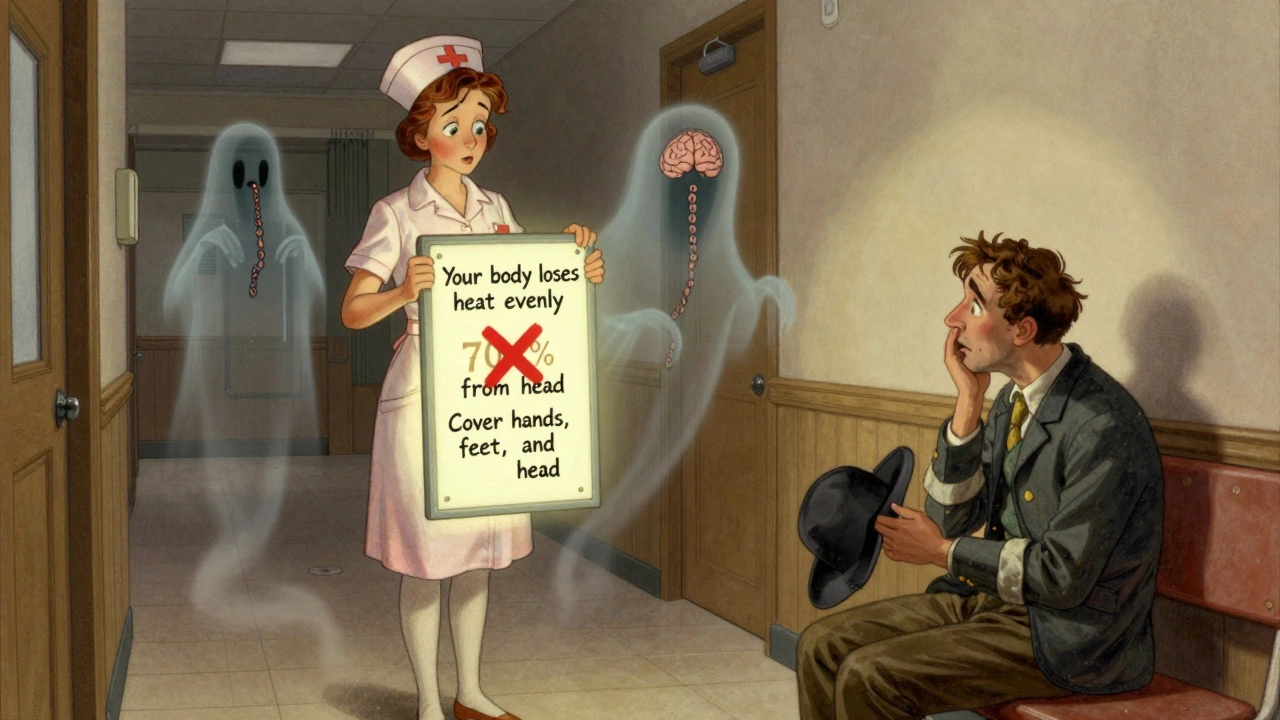
Just telling people they’re wrong doesn’t work. In fact, it can make things worse. That’s called the “backfire effect.” When people feel their beliefs are under attack, they double down. The most effective way to correct a myth is the “truth sandwich.”- Start with the truth. “Your body loses heat evenly across your skin-not just from your head.”
- Briefly mention the myth, clearly labeled as false. “Some people think you lose 70% of your heat through your head, but that’s not true.”
- End with the truth again. “Covering your head helps, but so does covering your hands and feet. All exposed skin contributes.”
Why this matters for your health
Believing myths can cost you more than money. It can delay real treatment. Someone might skip a cancer screening because they think “detox teas” will cure them. Or avoid vaccines because they believe a debunked link to autism. A 2023 study by the American Hospital Association found that when healthcare providers proactively address myths in patient education, adherence to medical advice increases by 31%. That’s huge. It means people are more likely to take their meds, show up for appointments, and follow lifestyle advice when they understand what’s real. Myths don’t disappear because we wish them away. They disappear when we replace them with clear, simple, repeated truths-delivered in a way that doesn’t make people feel stupid.What’s next for myth-busting?
Technology is helping. Google’s “About This Result” feature now adds context to search results. The World Health Organization’s Myth Busters page has corrected over 2,300 health myths across 187 countries. AI tools are being trained to spot emerging myths before they go viral. But the real power still lies with people. Parents correcting their kids. Nurses explaining things to patients. Friends sharing accurate info instead of转发 memes. You don’t need a degree to be a myth-buster. You just need to ask: “Where’s the evidence?” The next time you hear a health claim that sounds too good (or too scary) to be true-pause. Check it. Share the truth. One corrected myth at a time, we can make better health decisions possible.Is it true that you lose most of your body heat through your head?
No. The head makes up about 7-10% of your total body surface area, so it loses roughly that percentage of body heat when exposed. If you’re cold and your head is uncovered, you’ll lose heat there-but so will your hands, feet, or any other uncovered part. The idea that the head is special comes from a misinterpreted military study from the 1950s. Heat loss is proportional to surface area, not location.
Do I really need to drink eight glasses of water every day?
No. There’s no scientific basis for the eight-glass rule. Your total water needs come from all fluids-including coffee, tea, soup, fruits, and vegetables. Thirst is your body’s natural signal. If you’re not thirsty and your urine is light yellow, you’re likely well-hydrated. Drinking more than you need doesn’t give you extra benefits-it just means you’re peeing more.
Does sugar make children hyperactive?
No. Over 23 controlled, double-blind studies have found no link between sugar intake and increased hyperactivity in children. The belief persists because parents associate sugar with parties and excitement, but the behavior is caused by the event, not the candy. The myth was kept alive for decades by sugar industry funding of misleading research in the 1970s-1990s.
Is it true that we only use 10% of our brains?
No. Brain imaging technologies like fMRI show that every part of the brain is active during daily tasks-even simple ones like talking or walking. The 10% myth comes from a misinterpretation of early 20th-century psychology. There’s no unused brain tissue. If you damaged even a small area, it could affect movement, speech, memory, or emotion.
Are superfoods like acai or goji berries really better than regular fruits?
No. “Superfood” isn’t a scientific term-it’s a marketing label. Acai and goji berries have antioxidants, but so do blueberries, strawberries, and apples. The health benefits of these foods are not unique. Eating a variety of whole fruits, vegetables, whole grains, and legumes gives you more nutrients than any single “superfood” ever could. Paying extra for exotic berries won’t make you healthier than eating local, seasonal produce.
Can chewing gum really stay in your stomach for seven years?
No. While your body can’t digest gum, it doesn’t get stuck. Chewing gum passes through your digestive system intact and is excreted in stool within two to four days. Doctors have never seen a case where swallowed gum caused a blockage in a healthy person. The myth is used to scare kids, but it’s not based on biology.




Fern Marder
OMG YES 😭 I used to buy those $30 acai bowls until I realized my local blueberries cost $4 and have the same antioxidants. Why do we fall for this? 🤦♀️
ruiqing Jane
Finally someone said it. The eight-glass myth is pure marketing fluff. My body knows when it’s thirsty-no app needed. And yes, coffee counts. I’ve been drinking it for 15 years and my kidneys are still fine. Science > superstition.
Carolyn Woodard
It’s fascinating how cognitive biases and institutional incentives conspire to perpetuate these myths. The sugar-hyperactivity correlation, for instance, isn’t merely a misinterpretation-it’s a case study in confirmation bias amplified by corporate lobbying. The 10% brain myth, similarly, functions as a metaphysical placeholder for human potentiality, a narrative scaffold upon which self-help industries construct their value propositions. We don’t debunk myths because they’re false-we debunk them because they’re functionally corrosive to epistemic hygiene.
Allan maniero
I’ve been telling my kids for years that gum doesn’t stick in your stomach, but they still act like it’s a horror movie. Honestly, I think the real problem is how we treat kids like they’re fragile little porcelain dolls. Swallow a piece of gum? Big deal. It’s not going to kill them. The fact that this myth survives is more a commentary on how scared parents are of anything that isn’t perfectly controlled. Let them eat the gum. Let them be kids. The body’s got this.
william tao
This article is a textbook example of reductionist pseudoscience. You cite studies, yes-but you ignore the epistemological hierarchy of evidence. Meta-analyses are not infallible. The placebo effect is real. The fact that 23 studies found no sugar-hyperactivity link doesn’t mean the phenomenon doesn’t exist in ecological contexts. You’re replacing one dogma with another. And the ‘truth sandwich’? That’s just rhetorical gymnastics for people who can’t handle nuance.
Sandi Allen
Who funded these ‘studies’?! The sugar industry? The pharmaceutical industry? The CDC? The WHO? They’re all in bed together. You think they want you to know the truth? They want you to keep buying their ‘health’ products. The 8-glass myth? It’s designed to sell bottled water. The ‘superfood’ thing? It’s to push expensive supplements. The 10% brain myth? It’s to sell ‘brain boosters’! This whole thing is a cover-up. Wake up. The system is rigged.
Sheryl Lynn
Oh darling, the ‘truth sandwich’ is so *quaint*. It’s like serving a Michelin-starred amuse-bouche to someone who’s been eating cardboard for a decade. We don’t need gentle corrections-we need cultural recalibration. The myth-busting industrial complex is just another flavor of performative enlightenment. Real change happens when we stop treating people like children and start treating truth like a radical act. Also, ‘superfood’ is such a cringe term. It’s not about berries-it’s about sovereignty over your own nutrition. Eat what you love. Not what the Instagram algorithm tells you to love.
Paul Santos
Interesting how we anthropomorphize our bodies as if they’re passive vessels that need to be ‘corrected’ by science. The body doesn’t need myths-it needs narrative. The ‘eight glasses’ rule? It’s not wrong because it’s false-it’s wrong because it’s alienating. People don’t drink water because they’re told to. They drink it because it’s ritual. Because it’s comforting. Because it’s part of their identity. You can’t debunk a ritual with data. You need poetry. Or at least, a better story.